Saturday, May 17, 2014

Day 6: St George, Medieval gravity systems and the guy with the Mercedes

We had planned to hit Conisbrough on the way up to York a few days earlier, as it's only a few miles west of the A1, but the Bank Holiday snafu with the rental car squashed that plan flat. And actually, it was just as well. Had we actually managed to collect the car in Edgeware as planned and tried to hit the town and its two star attractions - the Castle and St Peter's Church - we would probably have been rushed for time to beat darkness. And neither of these places surrender their charms quickly.

I ducked into the car-park behind St Peter's church. We didn't see a sign saying not to, and didn't see the sign that actually said "Free Car Park"

Yeah, park it here mate. Conisbrough.
which might have been a dead giveaway that it was ok to park here, and as I had someone behind me, I made a fast executive decision, which was rewarded to my astonishment with an available spot to park the car, the only available spot. Right next to a Mercedes.

We didn't know this at the time, but the church is thought to be the oldest building in South Yorkshire, dating to the (say what ??) 8th century. Well, maybe we knew it long before we were actually there, but had forgotten. Either way, experience told us that pretty much any castle town in England is likely to have an awesome church nearby. With a churchyard. Count on it.

St Peter's doesn't look particularly old, at least from the outside.

Church of St Peter - Conisbrough
Much of the exterior fabric is constructed from neatly aligned and regularly arranged stonework, screaming late Victorian, and browsing the headstones in the churchyard did little to dispel that notion.

But as soon as entering the porch, you realize you're in the presence of serious antiquity - a sculpture in the porch is considered Romano-British (suggesting it was originally carved for an earlier structure somewhere else and moved here...), so weathered no one is certain whether it was a Madonna and child, or St Peter with the keys to Heaven. (I'm going with Madonna...).
St Peter with the keys to heaven...or Madonna and child.
St Peter's, Conisbrough

The interior of the church is heavy, cavernous and relatively unadorned by the Victorians - the walls are largely undressed stone, in some places constructed from masonry from a nearby Roman bath house. Thankfully, many of the church's antiquities have neat little exhibit labels - Sharon called the place the best labeled church ever.

St Peter's - Conisbrough


There are a number of medieval tomb cover slabs,
Tomb cover slab, c 14th century - St Peter's
including one which is thought to be the earliest sculpted depiction of St George confronting a dragon - in this case, defending a freaked out bishop from the fire-breathing beast. Look carefully: dragon in the center right (with a defeated knight underfoot), George with sword and shield at the left center, the besieged bishop clutching his crosier beside him.
Fie, ye evil beaste ! St George and the Dragon, St Peter's, Conisbrough
The church was a little intimidating - somewhat dark,
St Peter's - Conisbrough
desperately quiet, humming faintly with ancient religious symbolism and savory bits of death iconography. We loved it.

St Peter's - Conisbrough


We ambled down the road to the castle.

Down the hill toward Conisbrough Castle, just peeking over the rooftops on the right
The name 'Conisbrough' is derived from Old English, meaning 'the defended burh of the king,' but the name predates the castle itself, which was actually not a royal property. The extant structure was built sometime around 1180 by Hamelin Plantagenet, an illegitimate half-brother of Henry II and husband to Isabel, Countess of Surrey, descended from Norman nobility. Hamelin was a Crusader and lifelong supporter of Henry, even as his reign became troubled and his popularity eroded. Henry, it is worth mentioning, was a famously ambitious castle-builder himself. But this one was Hamelin's.

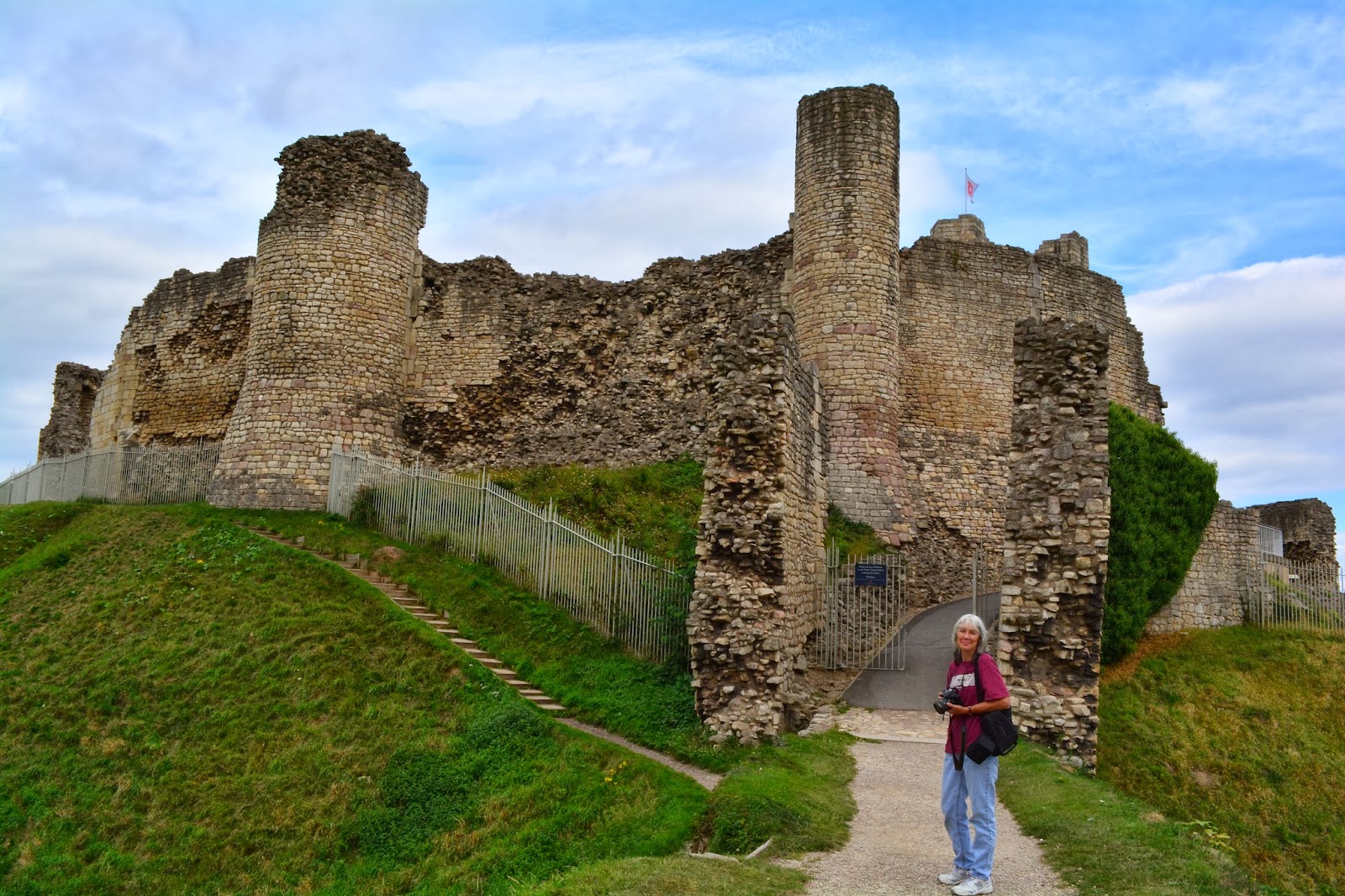
The place is imposing.
Conisbrough Castle 
But not unlike any number of extant early medieval castles, there isn't much once you get past the curtain wall. Conisbrough's keep is certainly impressive, but inside the castle walls was very little; the Great Hall was barely an outline on the grassy floor, the kitchen was a series of worn stone steps and flooring.

Remains of the Great Hall and kitchen - Inside the walls, Conisbrough Castle
There is a little jail behind the south side of the wall, its stone toilet still in place.
Jail and privy - Conisbrough Castle
The toilet suggests to people who study such things that the jail was a short-stay proposition, more like a time-out cell. Too small to be a dungeon, petty criminals would have been tossed in here to get their few-day corrective lesson in civic behavior; the hardcore bad guys were dealt with in some other way, somewhere else.

We walked through the keep, and followed the narrow and steep stairway upwards,
Stairway - Conisbrough Castle

Stairway - Conisbrough Castle
through a few rooms and eventually to the top, giving us a pretty nice view of the town and sweeping river valley below.


View from the top of the keep - Conisbrough Castle.
On the way up, another toilet. Indoor plumbing was still a few centuries away for the Britains - the guys who worked this place would take their privacy in these little vestibules, their bio-byproducts tumbling down the exterior of the keep.
Bombs away - Privy, Conisborough Castle.
Perhaps some unfortunate gob came by periodically to remove the pies. Or maybe not. One thing you learn reading about medieval times is that most people lived with the smell of shit, more or less all the time. Then again, it rains a lot in England - it could be that these things took care of themselves by the by.

It's a bit trivial to point out, but we'll do it anyway: every castle is different. Conisbrough had some terrific rooms, worn but ornate-in-their-own-way stone work under yawning arched ceilings....

Arched ceiling stonework - Conisbrough Castle
heavy wooden doors... really heavy wooden doors,

They don't make 'em like they used to - Conisborough Castle. 
circular rooms with defensively designed windows,

Castle room and fireplace - Conisbrough Castle

Castle room - Conisbrough Castle.


Window - Conisbrough Castle

Conisbrough Castle.


Except for some mild exhibit-grade lighting, and a few interpretative signs, we felt like we were in a castle. A bit of fantasy displacement that most modern Americans can only speculate about. You can't force this sensation, not in a place like Conisbrough that's a partial ruin and a partial functioning structure. You have to let it tells its story, fragmentary and suggestive as it may be, in whispers and subtle gestures.


Outside the walls, the castle is a looming testament to power, wealth and will...


inside the walls, a ghostly patchwork of ground-level stonework, hardly recognizable as anything (except the toilet)...inside the keep, the place resonates dimly with the clomp of boots and clanging of steel, the swoosh of lord-y garments, the hushed murmurs of strategy and power and intrigues.

In a sense, I appreciated it more after we left. It reminded me that the Tower of London, far larger and more complete and dating to an only slightly more distant time, had very little of this fantasy resonance - crammed with tourists and the flashing of cell-cameras off perspex displays, the Tower felt like a museum. This was a castle.

We might have been the last visitors to Conisbrough Castle for months - English Heritage was closing the Castle the next day for 'extensive renovations,' whatever that meant.

Getting back to the car, we met the owner of the Mercedes next to us. His name was Dave Steele; we chatted for some time about Yorkshire, the presence of tourists in this little town (they actually didn't get that many, he said), the durability of his beloved Benz and some recommendations for getting out of town. (Go out the way you came - the streets in the town center are really narrow..) He actually gave us his phone number and told us to look him up if we were ever by this way again - an odd and disarmingly friendly gesture. We still have it - and if we ever are there again, we'll ring him up and do tea.

Friday, March 7, 2014

On the road (Day 6, part 1): Saxon, she said

Drive day.

We knew it'd be a while before we'd be back in York (if ever), but we were also happy to wrap up a middling four-night stay at the Lady Anne and say goodbye to the Buzzard Sisters, who were faithfully holding court in the garden as we wheeled our luggage past them to the car.

York still holds an almost mystical grip on us both, but it was time to move on.

South, as the plan would have it, but like last year we started the route headed north. Sharon had pinned a couple of churches at Wigginton and Haxby, close-in York exurbs that seemed easy enough to fit into the schedule.
St Nicholas - Wigginton

Both villages are ancient, pre-dating the Domesday Book, but neither church was particularly historic. Wigginton's parish church (St Nicholas) was built in 1869, replacing an older structure from the fifteenth century, and Haxby's (St Mary) was built in 1878.

St Nicholas - Wigginton
Both pleasant and light churches with tidy Victorian churchyards.

St Mary - Haxby


St Mary - Haxby


Back on the road.

We'd had the next destination in our back pocket for a few days.

Chatting with Miss Jones at Kirkham Priory, we mentioned that we were really into old churches, and she recommended we make a stop at the Saxon-era St John the Baptist, in Kirk Hammerton.
St John the Baptist - Kirk Hammerton
Originally dedicated to St Quentin, rededicated (at some time unknown to historians) to St John the Baptist, the church is a really patchwork of Saxon, Norman and Victorian construction and remodeling, with the tower generally considered to be the oldest surviving (and unaltered) feature of the building, dating to about 950AD. This makes the place a little extraordinary - the Saxons didn't build many churches from stone, but researchers have found evidence of Roman tooling on some the churches oldest stonework, suggesting there may have been enough pilfer-able Roman stone laying about to build a church with, or at least some portion of a church tower.
St John the Baptist - Kirk Hammerton

Most of the churches we visited have a little guide book for the tourist, usually no more than a pamphlet commonly traded for a recommended donation of a pound or two. We donated gladly to every church, at least the ones we could gain access to; a little corner of our home office now hosts an irregularly stacked clutch of English parish church pamphleture, a pretty dire collection of arcana.

By contrast, Kirk Hammerton's guide is forty pages, detailing the history of the place (as much as is known, and a lot isn't), with grainy photos of long-dead benefactors and selected views of the building's features, as well as some commentary on the quality of various restorations and additions that the ancient church has endured. St John the Baptist escaped complete demolition at least once, in the 1780's, and some of the over-eager early Victorian restoration was subsequently and successfully reversed.

St John the Baptist - Kirk Hammerton
It's an interesting subject - well okay, a fairly obscure one, unless you're into the evolution of English churches, and we freely admit to suffering a mild dose of this affliction - regarding Victorian restoration. An awful lot of historic church restoration took place in the Victorian years, some estimates put that number as high as 80% of all the parish churches in England and Wales. Some of it was done gently and well, sensitive to the fragile and uniquely historic nature of some of these 11th and 12th century structures, and some of it heavy-handed and pitiless, boasting of the aesthetic tastes (and probably lofty egos) of the contracted architects involved.


Church attendance in the 19th century was dropping; maybe, somebody thought, it was in part due to expecting parishioners to sit on crude, creaky pews in drafty and crumbling Early English churches susceptible to catastrophic collapse at more or less any time. Maybe renewed and modernized ones would help bend that curve.

It didn't, of course, but at least on that level we can be assured that their intentions were virtuous. Or something.

And to be fair to the Victorians, some portion of their work was directed toward structures that were decaying toward irretrievable ruin. Some churches were saved from oblivion during the restoration frenzy. (And some weren't...here's one that wasn't, we'll get to this one in a few days.)


Not restored - St John, Stanton, Suffolk
So there's a bit of a box-of-chocolates effect with church crawling, at least the way we found ourselves doing it. In 2012, we used the Churches Conservation Trust website to point us to truly ancient places, but at some point we simply arrived at some realization that, at the risk of stating the obvious, England was a country brimming with villages and towns more than a millennium old, and virtually anywhere you go, you're going to find a church dating to the 12th or 13th century.

How much of that church had been once-overed by some bearded and furiously gesturing Victorian architect was usually not apparent until we creaked the door open and stepped inside. For a couple of antiquity-crazed American neophytes, we learned to savor that certain thrill in crossing the threshold into an ancient parish church, even if we knew that what awaited inside may not be a pristine time-capsule of medieval worship.

St John the Baptist, Kirk Hammerton
So we came to a leveling awareness that neither the Victorians of 150 years ago, nor the parish church councils of the early 21st century, necessarily subscribe to an over-arching priority of keeping The Old Stuff visible and accessible to tourists. A church needs to be a church, and sometimes that imperative collides with museum-grade antiquity.

But in reality, despite all the preceding blather about the Victorians and their re-costuming of ancient churches, Kirk Hammerton is a slightly different case study. In 1887, the place came under the benevolence of one Colonel EW Stanyforth, the grand-nephew son of the village's churchwardon. The church had already been enlarged twice, once in the twelfth century (it was already two hundred years old by then) and again in 1834, but in the 1890's Stanyfield commissioned much of what is visible today, especially the startlingly vibrant mural paintings.
St John the Baptist, Kirk Hammerton

St John the Baptist, Kirk Hammerton


Saxon chancel - St John the Baptist, Kirk Hammerton

The elegant and silently dignified Saxon chancel is the oldest portion of the church, and all there was to the place in the tenth century, but it's functionally a side chapel now.

The soaring artwork is the real star of the place, and that's barely a century and a quarter old. So a fair bit of the St John the Baptist is indeed Saxon, and the tower from the outside leaves little doubt as to its antiquity, but inside, the church beams and glows with its painted adornment. Stanyfield did this one right - the place is hypnotizing.

Saxon chancel, altar - St John the Baptist, Kirk Hammerton
We spent almost an hour inside, all by ourselves, almost speechless, the clicking of our camera shutters pinging meekly off the mute stone walls. It felt heavy, a somber and benevolent embrace.


Chancel - St John the Baptist, Kirk Hammerton


Saxon stonework - St John the Baptist, Kirk Hammerton

Saxon stonework - St John the Baptist, Kirk Hammerton
We shot the churchyard ...

Churchyard - St John the Baptist, Kirk Hammerton

Churchyard - St John the Baptist, Kirk Hammerton


Churchyard - St John the Baptist, Kirk Hammerton

and headed off next to pick off a highlight destination further south that we had missed on our first day.


It was time to get our castle on.

Saturday, February 15, 2014

Milestones

A friend of mine died last week.
Andrew Vause
Andrew was a tough bloke. I met him on a gaming forum that I used to frequent pretty regularly, a fourth generation internet descendant from the forum that grew out of the burgeoning Unreal fanbase of the late 1990's. A few of the original Unrealers are still there, but the site has gradually morphed into its own community - internet friends. A lot of the members don't even play computer games anymore.

Andrew had joined the forum, like many of the members, via a friend-of-a-friend, and he was generally regarded as something of a troll, and in the early days, an outsider. But we had PM'ed each other quite a bit - he was actually a very bright fellow, a sharp (if unforgiving) judge of character, and a guy who had endured health issues and really steep plunges into pitiless bad fortune. Job losses, failed relationships, unending trips to the hospital and so forth.

He lived in Middlesborough, northwest Yorkshire, and we had made a tenuous plan to actually meet up for an afternoon when we were in the area in 2013. It didn't work out. But we had talked via phone several times since then, most recently just last month.

He was an alcoholic, by his own admission, and I while I don't have any insight into how it affected his attempts to stabilize his life, it was obvious during our last conversation that he was circling the drain, psychologically and physically. I don't know what caused his demise in the end, whether medical misadventure or by his own hand (either seems possible, judging by our last talk), but in any case he lost his battle about 10 days ago. He was about 37.

Strange thing, isn't it? A guy I never met and with whom I had relatively little in common. But he was my friend, and now he's dead. I'll remember him.

*************

Yesterday I headed up to Loveland for a Friday-off day of skiing. I haven't skied much this year, for reasons ranging from cold weather to work pressures to (admittedly) a bit of laziness, but I was determined to get a day in. Presidents' Weekend usually means crushing crowds on Saturday and Sunday - I was hoping that Friday would be lighter.

It only really occurred to me last Tuesday that Friday would be my tenth wedding anniversary with Karin. And of course, we actually got married at Loveland, as part of the Mountaintop Matrimony thing they do every year.
Wedding Day - February 14, 2004
I don't write much anymore on being widowed from Karin - I may do so a bit this year, as I approach the ten year mark - recalling the event itself and the searing events of the following few months and the ensuing decade seems like the perfect opportunity for Deep Thoughts. But I don't really have any.

I remember the day ten years ago - sunny, mild, decent if less-than-heroic snow, a nice ceremony at the top of Lift 2, cake and Coors Light in the bar afterward. We were both very happy that day. And yesterday, ten years hence, the day was cloudy, cold, windy and snowing sideways, and I was up there just to ski, by myself. I never saw the happy couples at the top of Lift 2 - I suspect they moved the event indoors out of deference to the ferocious winds.

I'll always remember that day, but being there yesterday on the tenth anniversary didn't make me remember it any more or less. It was an oddly empty experience.    

Saturday, February 1, 2014

Yorkshire (Day 5, part 2): Desmond, The Lord Mayor's daughters and the churchyard that wasn't there, but was

Well, we were going to amble off church-strolling, but we shot a lot of pictures that morning and Sharon's battery was running low. We headed back to the hotel for a quick shot of 220V juice.

Along the way, in front of a bakery on Bridge Street, we encountered Desmond. Homeless guy, junkie or semi-pro pan handler, we couldn't tell, but he was affable and flattering in a vaguely fragrant sort of way. I had a little trouble understanding him, but the part I did get was him hitting me up for a smoke and some loose change - I was unaware of the prevailing tourist etiquette regarding street folk in York (or in England generally, not that we encountered very many), so I gave him my three-left pack and a two pound coin. Actually Sharon gave him that, since I didn't carry the coins. They continue to baffle me and thus are not safe on my person.

Sensing a potential mother-lode of unbounded tourist benevolence, he thanked me for the smokes and called his friend over and urged us to contribute similarly. I thought about offering to buy them both a pastry, the soft aroma of fresh baked goods attending our negotiations...but honestly, how stupid would that have been?

Sorry mate, and we wandered off, and thankfully he didn't follow.

Got back to the hotel. The Buzzard Sisters were there - our faithful garden statuaries. Hello ladies, etc...

On the way back to town, we stopped off at All Saints North Street.
All Saints North St - York
We'd passed this church any number of times, including that morning when we were discouraged away out of deference to some sort of function (a funeral maybe, or a meeting...maybe services), but finally we had our chance to go inside.

Even by the standards of York, the place is ancient; the first known reference to the church comes from 1089, although it is uncertain how much of that building - probably a plain rectangular affair, safely assuming Saxon origins - remains today. Some of the 14th century additions and improvements were made with Roman 'gritstone' found on the site, and the 120' steeple was added in the late 15th century.

The place lurks behind some tall trees, a little gloomy and mysterious, but inside it was light and hummed with the confidence of an active parish church. We both liked the place.
All Saints North St - York

All Saints North St - York

All Saints North St - York


All Saints North St - York
 All Saints Pavement was next, situated right on one of the city centre's busy main streets.

All Saints Pavement - York
The churchyard was a bit cramped, with barely-legible 18th century headstones pulled in tightly to the church itself and just across a paved, churchyard-bisecting alley, leading one to the easy presumption that there are probably some folk buried underneath the walkway.


All Saints Pavement churchyard - York

All Saints Pavement churchyard - York


We wouldn't expect the locals in York - or I suppose, almost anywhere in England - to be troubled by this. York has been occupied continuously since 71AD - there are dead guys in the ground everywhere, and everybody knows it. At the risk of sounding tritely macabre, it's one of the things we like about the place.

The extant church is mainly 14th and 15th century, though local tradition tells us that a church has stood here since the 7th century, originally founded in dedication to St Cuthbert.

All Saints was rebuilt in the 19th century to accommodate the growing city around it - the east wall features a resplendent stained glass window from Victorian days,

All Saints Pavement, with rebuilt east wall and 17th century pulpit - York
Font cover, All Saints Pavement - York
and the outline of the rebuilt east wall is clearly visible against the earlier building fabric. The pulpit was installed in 1634 - the little roof is called a 'tester', a feature designed to enhance the preacher's acoustic reach. One preacher who it is thought benefited by this device was John Wesley, the founder of the Methodist movement, who preached here in the 18th century.

The church is known as the burial place for more than 3 dozen of York's Lord Mayors; we found a brass memorializing two daughters of one of them, Andrew Trew, who was a tailor and draper by trade (which, evidently, was a position of significant distinction in late Tudor York) and who served as Lord Mayor in 1585. His daughters, Marie aged 36 and Margerie aged 37, died in 1600...

'They ar not dead but sleppythe' - Trew memorial, c1600. All Saints Pavement - York

...and this guy, probably likewise a Lord Mayor but whose identity appears to be an un-captioned mystery. Snappy dresser. The brass is covered by a glass casement, making it a little tough to photograph.

Unidentified brass. All Saints Pavement - York
Being the rich-guy's church, All Saints Pavement has a lot written about it. But St Saviour doesn't.

St Saviour - York
Like St John's, St Saviour isn't really a church anymore.

The place is now called Dig, a hands-on archaeology exhibit primarily for kids, supported by the York Archaeological Trust. We knew that when we went in - there was a smiling girl behind a trim and modern desk, at the back of the nave where a font would have stood six hundred years ago. Admission price on a placard on the desk, with a couple of exhibit cases with sand and colored plastic shovels behind it. Dead guys in the floor - thankfully, no one digging at them.
St Saviour - York


The place was quiet and kidless.

I smiled and said hello, she seemed a little surprised to see me. I thought Sharon was behind me.

I wasn't interested in playing in the sand (although sometimes I am), so I inquired whether there was a churchyard around back. Kind of a stupid question, I could have easily gone and looked myself, but I felt I needed to say something to her. Big smile back, "no, I'm sorry," she said, cannily anticipating my disappointment that the only dead guys I was likely to photograph were inside the church, in the floor, irregularly covered over by exhibit boxes with sand and colored plastic shovels.

Then Sharon came up behind me, said I needed to come outside. I told her that the girl behind the desk said that there was no churchyard. "Oh yeah?" said Sharon, and sure enough, around the back of the church was a churchyard...
St Saviour churchyard - York

St Saviour churchyard - York
well, kind of a churchyard, as most of the stones had been removed from their original plots and lined up around the property wall, shrouded in flora.

We were used to this by now - a lot of church minders in England remove the older churchyard headstones and lean them up against the building itself, or around the stone wall should the property have one (and most do.) It makes it easier to cut the grass - honestly, that's a big deal - and especially at churches where the yard is used for social or community functions, it opens the space up. By this time, whenever we encountered the shuffled-headstone thing, we'd quote an eighties film to each other. Ya only moved the headstones. 

There was a time, when we were first planning a trip to York in early 2012, that we were quite intent on doing Dig. It's mentioned prominently in the tourist guide books, as is the Jorvik Centre, a Viking exhibit from which we were warned off by a nice gentleman from Leeds who we met at the top of the York Minster in 2012 ("waste of time, and it smells bad in there too!"). Likewise, our interest in Dig  had waned to nothing by the time we got there on the 2013 trip. It was a subtle irony; we're both interested in archaeology, but we ended up coming to St Saviour just to see the church.

And truth be told, we had developed such a fondness for ancient English churches that the re-purposed ones left us chilled and a little sad. St Saviour had the body of a church, but the soul of a keep-the-kids-occupied tourist attraction.

But at least St Saviour was still stands with some measure of dignity,
St Saviour - York
and its sort-of churchyard still whispers the names of its long-dead parishioners...

St Saviour churchyard - York
...at least until someone moves the headstones again, or the names dissolve into the weather-exposed stone. Or the Dig exhibit fails and the whole place gets plowed under.

And we still don't know why the girl at the desk didn't know they were there.