Monday, January 28, 2013

Shrewsbury: Monks For Sale, Green Day and The Dingle


We headed out up the impossibly narrow St Julian’s Friars  


and headed left up Beeches Lane.

The lane turns into the Town Walls St, which traces the medieval defensive wall around the city center built by Henry II in 1216, little of which remains with the exception of this small guard tower dating from the fourteenth century, listing notably inward. (Unless the adjoining houses were listing notably outward - by this time, either seemed possible to me...)


The tower is open a few times a year and is in the care of the National Trust.

Along the way, we came upon Shrewsbury Cathedral, one of the town’s landmarks (although, hardly ancient, as it was consecrated in 1856.), quiet and still in the harsh light of late afternoon, at the outskirts of the town center on the curiously deserted street. 

The gate was locked, so we couldn’t go inside. By the photos we have seen, the place is quite grand on the inside, but from the sidewalk, it left little impression on us.

Old St Chad’s Church was next, a block or two away. 

The church, built on the site of an eight century monastic building, dates to the late 12th century, although much of it collapsed (“spectacularly”, as the interpretative plaque tells us) in 1788, with only the original Lady Chapel remaining of the original structure. It is thought this was one of the very earliest occupied post-Roman sites in Shrewsbury. Unsurprisingly, we shot the churchyard around it, and also unsurprisingly, the church was locked.

Apparently some nasty things happened in Shrewsbury in the Middle Ages, too. 


We found our way next to St Alkmond’s, St Mary the Virgin and eventually (the new) St Chad’s Church, which the Victorian-era (and much larger) successor to the Old St Chad’s. It sits right across the street from The Quarry, Shrewsbury’s large municipal park which slopes down the River Severn and which encompasses a gardened area known as The Dingle…a name we had a little cheap, foreigner fun with. The Quarry also features an immense statue of Michael the Archangel, a WWI Memorial erected in the 1920’s.


The park was a green and pleasant expanse; lots of folks out strolling, laying in the grass reading, walking their dogs etc. The church is immense and imposing, but also locked, as were the gates around the gardened grounds and the small, neatly arranged churchyard. We were starting to get the picture; churches in the cities tend to be locked during off-hours, churches in the villages tend to be left open for the public. Not a hard and fast rule, but generally speaking. 

The town itself was picturesque, lots of Tudor buildings and winding, narrow streets, brightened by loads of flowers enjoying the sunny, warm days of early September. 


This is the mansion (on the left) built for wealthy wool trader John Ireland, in 1596.


Shrewsbury is also the birthplace of one of England’s Favorite Sons, Charles Darwin (whose tomb we saw a few days later, at Westminster Abbey), which we were reminded of at sometimes unexpected intervals, 

but that wasn’t the real reason we were there. Actually, the only real reason we came to Shrewsbury was because it seemed a logical waypoint for our next leg southeast to the Cotswolds, and its relatively close proximity to Wigmore Castle, one of the first ruined castle sites we identified when scoping out the trip months earlier. 

Shrewsbury exhibits a kind of subdued pride that we found uncommon elsewhere (York is much different, more obviously a museum and college town), but for some reason – really quite inexplicable to me – it was the first time walking along an English street where I felt conspicuously foreign. Not unwelcome, but just a tourist strolling about somewhat pointlessly in a working English city. Maybe it was Mary’s remark a few days earlier (“Why would you want to go there?”)  It was an odd sensation and a little unsettling for me, at least for a little while.

We decided not to be too picky about dinner – by this time we had already scratched our Yank-tourist-in-Britain itch for “real” English pubs – so we just popped in a place called The Hole In The Wall (Sharon tells me it’s a chain). It was Friday night and the place was busy and boisterous. We found a small table across from the bar – a clatch of locals, including a conspicuously bar-flyish and cackle-prone middle aged lady with blond hair, ill-advised shorts and a probably flammable blood-alcohol quotient, were swilling enthusiastically nearby.

Our table was stationed just beside a post supporting a jukebox. A band was just starting up in the downstairs area not far away, but the jukebox next to us was being manned by a guy in his early twenties punching up Green Day songs and standing there, facing the machine, nodding approvingly to the music. He wandered off a time or two, but kept coming back, feeding his habit with those odd English coins I still haven’t deciphered. Didn’t seem intoxicated; just a dateless young man, burning a Friday night mainlining Billy Jo down at the pub. A perfectly respectable cover band was cranking away nearby, but he was oblivious. It conjured in my mind a line or two from the Kinks' “Rock and Roll Fantasy.” We found it funny and not at all annoying (Sharon likes Green Day), and somehow a little reassuring to me that England was still growing a rock ‘n roll fan or two.

The barkeep brought our food out (bangers and mash for me, fish and chips for Sharon), and when we asked him, offhandedly, if he knew where Darwin’s birthplace was, he went back to find his manager and returned with a tourist map, giving us directions with circles and arrows. It was no small gesture –I’ve worked behind bars on Friday nights, and the guy went out of his way to give us some tourist directions at possibly the busiest hour of the entire working week. I felt a little bad about it, since we hadn’t budgeted any time to see Darwin’s birthplace anyway and it wasn’t likely that we’d be able to the next morning. He gave us a customer satisfaction card, which we dutifully filled out, giving them high marks all around. We still have the map. 

On the way back to the hotel, we stopped off at another pub, ordered up a couple of ciders and sipped them in the cooling night air at an outdoor table. 

Shrewsbury. I was starting to like the place.

Wednesday, January 9, 2013

Shropshire


Wiped out from a very long previous day and almost no sleep, we checked out of the Bestwood Lodge at around 9 in the morning and headed west toward Shropshire, and Shrewsbury, our next bed. Sharon caught a cool picture of a dove in one of the hotel's sculpted facades.

I was groggy and a little cranky, fending off a hint of skepticism that we had planned the middle portion of this trip a bit too ambitiously. There were a handful of moments when I glowered with bitterness about the driving – not so much that I was doing it all, since Sharon had developed a conductor’s mastery of the GPS and without it we’d probably still be there – but just that I was still distrustful of the vehicle and feeling like any day could visit utter catastrophe on us. A moment of forgetting which side of the road to be on, a fleeting lapse checking the oncoming traffic, grossly misinterpreting the meaning of a street sign. Our own “fooking piece 'o shit” moment could be out there, waiting to deliver infamy and misery on us at any time.  
I recalled a post on a travel site that I read months before about an American couple who also planned a driving trip through England, their first time, and abandoned the car after two days, shaken and rattled to the point of utter capitulation. I didn’t consider that an active option for us – we were on a tight budget and converting the whole deal to buses and trains would have screwed both the itinerary and our wallets – but at least I knew how that anonymous couple felt. There’s an unexpected component of re-learning the nuances and cadences of driving, and after almost forty years of driving stateside, that piece came as a surprise to me. The last time I learned how to drive I was 16 and invincible, in a car about three times the size of this twitchy little VW.      

Our planned route took us through Nottingham proper that morning - we got to see the cemetery again, from the car – and a couple of dicey turns and the crush of rush hour traffic had me on edge almost immediately. We finally made it onto the A52, headed toward Derby (for us Yanks, pronounced “Darby”), feeling like I had managed to survive another tangle of fast, busy English county roads. But as soon as I let my guard down, I screwed up in a roundabout, ending up lost and sandwiched between buses and trucks in Derby itself. What we saw of the city reminded us a bit of rust-belt urban America, big and undistinguished warehouses and office buildings, although the city itself dates to Roman times and I’m fairly certain we missed the historic section. Our faithful GPS guided us patiently through a string of death-defying left turns and we were square again in a few minutes, eventually finding our way to the M6 headed south, then the M54 headed west.
We made to Shropshire after a couple of thankfully uneventful hours driving through the riotously green, heavily agricultural Midlands, skirting the madness of Birmingham and its large metro area from the north.

Next stop was Buildwas Abbey, another ruined Cistercian mission, founded in 1135. 


Smaller than the ruins in Yorkshire, Buildwas was an oddly compelling site, due in part to the several still-roofed rooms at one end of the site. Buildwas felt like a place


We were nearly the only people there, and we spent several minutes chatting with the English Heritage lady at the gift shop – she was a local and explained that several of the very old houses in the community were built in part with stone pilfered from the Abbey itself, in the years after Henry’s Dissolution.

And fresh from a ghost hunt the night before, I did a few EVP recordings in the quiet places around the abbey ruins, coaxing the spirits of the monks in my unconvincing French.


We also picked up a friend.

Off again, this time to Wenlock Priory, at the outskirts of the Shrewsbury metro area. The priory, part of the Cluniac order, is located on the site of a monastery dating to the seventh century and is thought to be the resting place of St Milburga, a Benedictine abbess who died in the early 8th century. 


There are handful of privately owned (and more recently constructed) buildings on the site, inaccessible to the public, but the Priory ruins themselves were a treat, laced with an immaculate and slightly creepy topiary garden.


We also visited the local church, Holy Trinity, at the center the tiny village adjoining the priory (Much Wenlock) and shot the cemetery; it was mid afternoon and the local moms were picking up their kids from school. The cemetery had an odd feel to it – unexpectedly heavy around the back side of the church, despite the bright and warm summer afternoon, quite possibly the most perfect weather day we had while in the UK.  

Hobbling into Shrewsbury, an ancient market town a mere nine miles from the Welsh border, we found our hotel without much trouble, the tourist-luringly named Abbot’s Mead, and thankfully found a spot, maybe the last one, in the hotel's tiny car park. Sharon got out of the car to guide me in. I had lost all car-park-incompetence-shame about two hotels ago. 

The gameplan was more or less routine by now – we climbed some steep stairs, entered a nice if unremarkable hotel room looking out over the street, dumped the bags and charged up the devices. We had each shot several dozen pictures since the last battery charge, and while Sharon’s Nikon seemed to possess a freakishly long charge cycle, I typically had to change batteries at least once a day…sometimes twice. By evening, I had at least two batteries to charge up…a few evenings, three. Plus the laptop. Our phones didn't work over there, we rented one from Verizon before we left; just as well, we mugged every plug in every hotel room, every night. At night, we dimmed the country. 
Sharon had mapped out the churches and churchyards ahead of time, at least the ones in the city center, so we figured we’d use the early evening light to shoot them and then find someplace for a bite, opting this time to skip getting a recommendation from the hotel gentleman and just roll the dice.

Wednesday, December 26, 2012

Chasing ghosts - Nottingham


We hurried back inside after our dinner and I checked the email. The guys asked us to meet them at Annesley Hall, a ruined medieval manor house owned for centuries by the Chaworth family. (Mary Chaworth was the boyhood lover of Lord Byron). The place – a sprawling estate with a ruined Norman-era chapel, churchyard and stables on the grounds - was now in private hands, with estimates for its restoration at something like 20 million GBP. We were told that the Nottingham county government had wanted to purchase and open the place as a tourist attraction, but the owner wouldn't sell, evidently preferring to just sit on it.

Ghost hunting groups often have a weird vibe about outsiders; in the States, there is an undeniable undercurrent of competition amongst groups for outside media coverage and the usually limited availability of credible investigation sites, while the pool of amateur ghost hunters (and, technically, there’s no such thing as a professional group, for reasons which should be obvious) has exploded due the popularity of a ceaseless parade of reality TV shows around ghost hunting. There’s also a kind fraternal element to the subculture – groups pride themselves on the currency of their equipment and the quality of their evidence, exuding the same kind of pride you might find amongst classic car owners showing their rebuilt muscle cars, trading notes on parts and 0-60 strip timings.

But the bunch we hooked up with, who call themselves PAST Hauntings, were warm and welcoming to us.

Their directions in the email were a bit sketchy – no problem, I thought, we’d just look the place up on Google and pipe the directions into the GPS. Ah, but not so simple, since there were three or four properties in the area with the name "Annesley", so we kind of took the written instructions and triangulated against Google and figured we’d find it. And we kind of did, although we waited on a lonely dead end street for 20 minutes until climbing back into the car and prowling around a bit more until we found the right street.

Sean was the group’s leader, a stout, enthusiastic bloke of about 40, a Nottingham cabbie by day and longtime ghost hunter. His tech guy was Simon, who worked at a local casino (we didn't know that there were any casinos in England), and Sean’s daughter Sian and a younger fellow Ashley were also along, all piled in Sean’s tiny hatchback with a few suitcases of equipment.

We deployed the digitalia and spent a couple of hours walking around the ruined chapel, dodging and occasionally tripping over 18th century headstones, and outside the fence of the estate itself, as well as shooting pictures and doing some recordings down at the stable. Ghost hunting, especially in a group, tends not to be very spooky (at least not for us, anyway), since you're usually focused on team management and equipment, and a lot of the time we spent at Annesley was exchanging  notes with the group on English ghost hunting and sharing commentary on the current state of para-TV. But Sharon and I, after some years of stomping around private B&B’s and mansions in the US, couldn't resist  a palpable rush of excitement prowling around a centuries-old churchyard and manor grounds in England.
We caught one interesting piece of still photo evidence, shot through an open window in the stables:


We're cautiously writing off this unusual image as the flash-illuminated image of some cobwebs in front of the camera, although we'll concede we've never caught anything quite like it before. 

Also, in addition to one decidedly peculiar piece of audio captured on my video camera, below (the voice at the end of the clip, which sounds French to our ears, was not from anyone in the group - I know a little bit, strands and fragments from French class in high school almost forty years ago that I'm generally not predisposed to showing off to anyone, and no one else in the group knew any at all):


But later, I did witness what in even my most cautious estimate was probably something of note; down at the stables, against the dimly lit and 60-yard distant walls of the estate itself, I saw what looked a lot like a growing black mass, a cloudlike apparition that obscured the building across the courtyard. It only last a few seconds, but it was enough for me to exclaim “Holy crap, did you see that?” to Sean who was standing at my side at the time. “I did,” he said, almost matter-of-fact. “Yeah, people see that a lot here.” There was a dim veil of ambient light from some distant streetlamps, as well as occasional brightening and darkening from the very light traffic along that street, maybe a mile distant, but what I saw was definitely not a product of ambient light. 


An English ghost? Well, maybe…in any case, my camcorder wasn't running at the time (sounds a little odd, but despite the usual battery of devices and cameras usually deployed at one of these ghost hunts, a lot what does happen isn't captured on anything, for a variety of reasons...), and it may not have recorded the apparition anyway, since even with an add-on IR light, the camcorder is fairly feeble in low-light outdoor settings. But I have no doubt I actually saw it. We've been on several dozen no-evidence investigations, but this struck me as something like The Real Deal. We've got a post up on our other blog about the Annesley Hall investigation, here.


After a couple of hours, we piled into the cars (I told them I'd follow, making them promise not to lose me along the way, since we had no idea where we were going) and made our way over to Colwick Old Church, another ruined church (there were small trees growing within its roofless walls) and churchyard on the south side of Nottingham, and walked around there for an hour and a half, shooting pictures and running the voice recorder. There are stories about the sighting of a Lady in White who is seen breezing her way through the cemetery, thought to be the spirit of a certain Mrs. Saville, who was murdered by an enraged husband in the nearby woods in 1844. There is also the grave site of an Elizabeth Swinscoe, d.1777... 


with whom the PAST guys have had a number of interesting EMF Q&A sessions in past. We didn't capture or witness anything extraordinary at Elizabeth's grave, apart from admiring the truly amazing (though broken and repaired) headstone bearing her name. I had a couple of fleeting but notable hits on the MEL meter nearby the grave, but nothing corroborating the EMF spikes.  

At about 1 AM, we all decided to call it a night – we punched up the hotel on the GPS, thanked the group and headed back to Bestwood. Nottingham streets were all but deserted by this time; along Mansfield Road we drove by the famed Rock Cemetery, the old (1840’s) city cemetery at the north end of downtown Nottingham. This had been one of our target graveyards for the trip, we had been hoping to get into Nottingham early enough the day before to visit and shoot it, but a view from the car window, at 2 in the morning, was all we were going to get out of it. We had a lot of driving awaiting us the next day, with no time to drive back into downtown in the morning (to say nothing of finding a place to park, which we were told is a challenge), and we were looking at next to no sleep.

Back at the hotel, we decided to grab a nightcap. (There's always time for that.) The bar, we'd been told, was open 24hrs/day, but we had to find the night watchman to actually fix us a drink, which we sipped at a table in the front courtyard in the stillness of an early weekday morning. We finally got up to the room and dropped off into exhausted sleep around 2:15 AM, wrapping up what was a ridiculously ambitious but successful day. 

Shropshire and the West Midlands was next.  

Sunday, November 25, 2012

York to Nottingham, the long way


Driving day again, we woke up a little hazy from the night before. I took a quick shower, we packed up and checked out of the hotel. 

The car was lodged into a maddeningly tight parking space, and despite my best 7-point turn, I couldn't seem to get the thing out. A guy exiting the gym came up to my window and offered in a crisp Eastern European accent to dislodge the VW for me – I was a little embarrassed that my de-parking skills had elicited the charity of strangers, but the guy smiled and said he parked cars for a living and this was a no-brainer for him, and he understood that American tourists had a little trouble with the tight spaces. I never really got comfortable with that car. Or most parking lots, for that matter. Car parks, as they say.

We were off to Nottingham. We had contacted a local ghost-hunting team over the Internet months before and they offered to take us out for an investigation. I was excited by the prospect. This whole trip was, after all, the Dead Englishmen Tour, and tonight promised to be dead guys up close, in the dark. Rock Cemetery, the city's oldest municipal burying ground, also looked promising, but I had some doubt we'd have time to see it.

Nottingham is south of York, a couple of hours if you take the fast way, but instead we headed north toward Rievaulx Abbey, Byland Abbey and Helmsley Castle. This was going to be one of our longest driving days; I tried as best I could to re-steel my road nerves, which had slackened the previous day walking around York.
We hopped on the B1363 and headed north out of town. 

Along the way, we came upon Gilling East, an historic and quiet village considered something of a York exurb. We had made no prior plans to stop there, but I spied the church on the main drag, pulled the car off the road and parked. The spontaneity thing again; in earlier years, I had found myself in periods of lethal boredom watching Rick Steves travel programs on PBS, at a time when a trip to Europe was as likely for me as a trip to Mars, but one thing I did take away from them was his unerringly emphatic tip to stop at unplanned places and just walk around. You can’t do that on a bus tour, and I figured this soft morning in Yorkshire was as good a time as any to liberate my Inner Steves. 

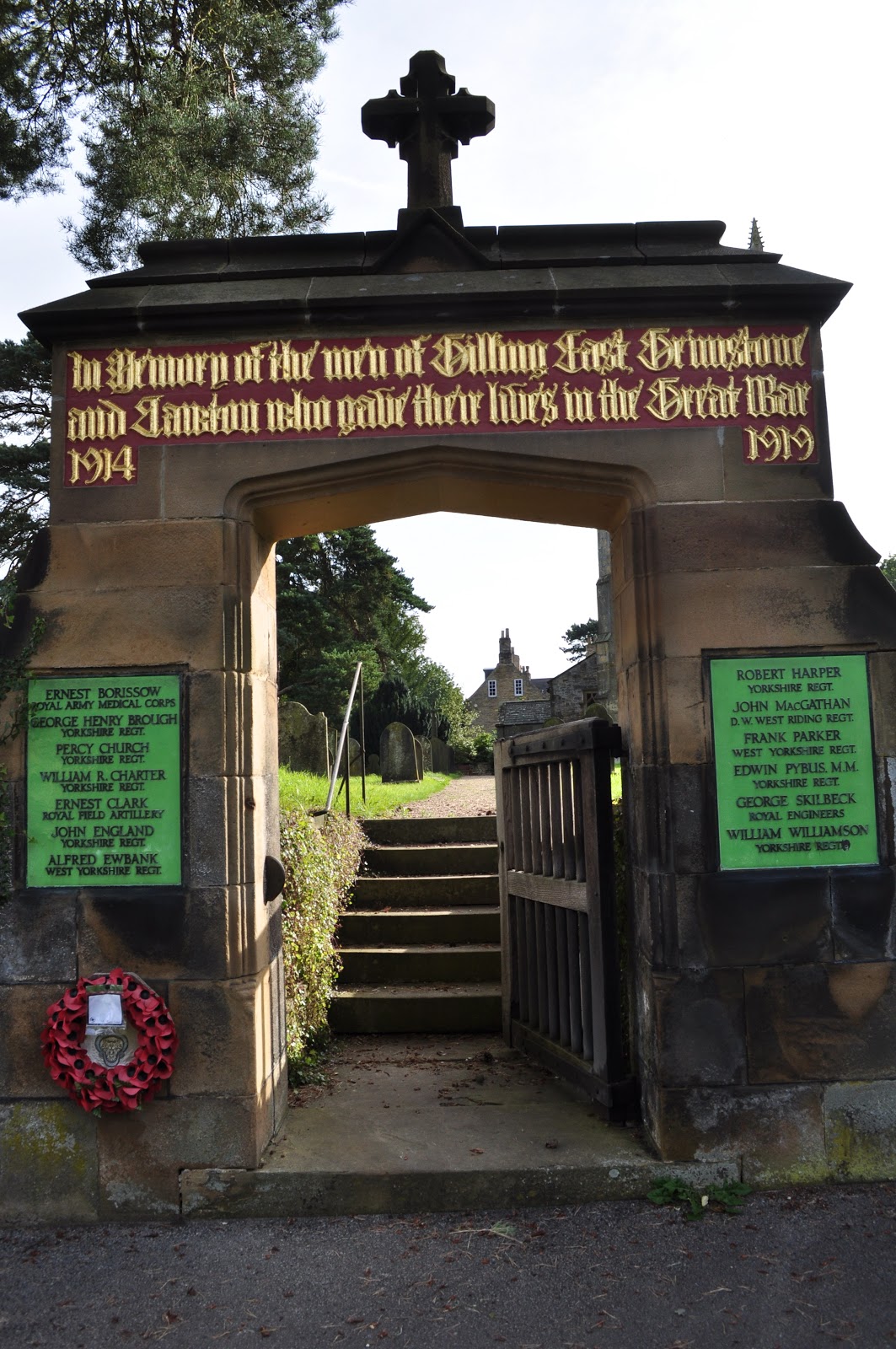
A nice lady visiting the church, a local, said hello to us as we entered the churchyard of Holy Cross. She seemed pleased we had stopped to visit, asked where we were headed (“ah, so you’re going north, to go to Nottingham,” she noted dryly) and invited us to go inside. At the entrance to the churchyard stood an immense and ornate memorial archway dedicated to the area’s fallen WW1 soldiers; WW1 memorials are a common site everywhere in England, a reminder of the generation-rending scars England still bears from that war, now almost a century ago.


The church itself was fascinating, dating to pre-Norman times and including the tomb of an unknown knight in the sanctuary. The visitor’s sign indicated he may have been the church’s founder, but the age and identity of the sarcophagus is known only to history. 


The church also housed the tombs of Sir Nicholas Fairfax, 3 times High Sheriff of Yorkshire in the 16th century and something of a heroic figure in challenging Henry VIII's pogrom against the Catholic establishment, and his two wives.  


Here's a bit we found (after the fact) about Fairfax. 
In Oct of the same year a rising took place in Lincolnshire and 6 days later the rising in Yorkshire began with a great assembly in the East Riding. Fairfax was one of the Yorkshire gentlemen who received a letter from King Henry VIII commanding him to aid in repressing "certain traitors" and "suffer by dint and sword or else so yield that the ringleaders be committed to prison" to await trial. But Sir Nicholas was more inclined to join the "traitors" than to obey the King’s command. Sir Thomas Percy sent for Sir Nicholas Fairfax to attend a muster of 10,000 men at Malton. 
William Stapleton, in his account of the rebellion, says that on Saturday 21st Oct he came to York and heard how Sir Thomas Percy and Sir Nicholas Fayerfax, with the Abbot of St. Mary’s York, had gone to Pontefract (Pomfret) with a goodly band the same day. Meanwhile the Duke of Norfolk was marching north against the rebels. It was obvious that the Duke was inclined to be lenient and begged that King not to reprimand him for any concessions he might make. However, on reaching Doncaster he met a deputation from Pomfret. It would appear that Norfolk was persuaded that he had the inferior force and on 27th Oct an agreement was made, the King’s pardon published and the rebels were dismissed to their homes. The King however demanded 10 ringleaders to be delivered to him.
Fairfax, notwithstanding their promise to the King, moved that the parishes of Dent and Sedbar might rise and raise both Lancashire and Cheshire. It was decided to rally the Abbots of the Yorkshire Abbeys, remembering that Gilling Church had been given to St. Mary’s Abbey, York many years before. On Dec 2nd the rebels held a gathering of lords, laymen, and clergy; the Archbishop of York preached. Among them were Sir Nicholas Fairfax, Sir William Fairfax of Steeton, Sir George Darcy (Nicholas’s brother-in-law), Sir Henry Gascoyne (Sir Nicholas’s cousin), and Mr Palmes (perhaps a cousin of Sir Nicholas’s wife). At this meeting they accepted the granting of a full pardon but no conditions as to the arrest of ringleaders. Sir Nicholas succeeded in making his peace with the King and was pardoned on 18th Jan 1537. He took no further part in a subsequent abortive rebellion: he had had enough.
The connection to St Mary's Abbey was a coincidence (we had just walked around the place the day before) that we were unaware of until after we got home. You can walk around and photograph the history, or you can bury yourself in it; thankfully, there's plenty in between. Gilling East was a small place, not necessarily on any tourist-guide must-see lists, but if we go back to Yorkshire, I'd like to see it again.


Helmsley Castle was next. 


Built by Robert de Ros in the late 12th century, the castle is one of many in the care of English Heritage, although it is privately owned. Most of the fortifications are in ruins, having suffered significant damage during the English Civil War (c. 1640’s), although the manor house and apartment buildings are in good shape, and some of the 15th century rooms are still intact with original wood furnishings and trim.


The place was intriguing; our first real exposure to mostly-intact medieval interiors (apart from the churches), and it took some time to see the whole facility. There was a light scattering of fellow visitors as well. Ruined castles play tricks on your sense of time and space – large open areas, laced with occasional exposure of foundation, peripherally marked by large and irregularly ruined keeps or houses, usually from different eras and betraying different building styles. 


Your mind wants to associate them all to a single notch on history’s timeline, but it’s actually a little more like stratography, where you’re seeing the passage of centuries, a sequence of building and destruction, re-building, remodeling, neglect and restoration. The reality is that you have to de-compress the centuries and understand these sites as processes. Just because what you see is hundreds of years old doesn’t mean it existed whole at any one time.  It challenges a two dimensional view of these sites, and all the large historical ruins we visited were like this.


A massive Cistercian ruin, once one of the largest and most prosperous Cistercian Abbeys in all of England, this enormous mission was established in 1132 and fell to ruin at the hands of Henry VIII in 1538, and is considered second only to Fountains Abbey in renown. The place absolutely dwarfs the ruin at Whitby which we saw two days earlier, and is far larger than the view we got from the road that day.

Many of the ruined abbeys were scavenged for their stone by neighboring villages (much of the lead and other metals were plundered by Henry’s troops), but Rievaulx stands far less pillaged than many of the others in part due to its location deep in a river valley in North Yorkshire – it was simply too difficult for  the area villagers to remove the massive stone blocks up the steep banks of the valley. The road in was by far the steepest and one of the narrowest we drove the entire two weeks in England.

Rievaulx is a shattering experience up close. The monks working this property diverted the river Rye three times out to accommodate their building projects, and they also built a prototype blast furnace at nearby Laskill, producing smelted metals of refinement far beyond anything else being produced at the time. It has been said that the closure and dispersion of the Rievaulx mission delayed the onset of the Industrial Revolution by two and a half centuries.

The church columns and arches are largely intact, and the chapterhouse, dormitories and other buildings are at the very least well defined around the church itself. In some respects, it is a difficult place to photograph; the scale and breadth of the place is absolutely vital to the experience. 


A nearby building features an exhibit of the life of the Cistercian monks, and a tiny village adjoining the abbey property – thatched roofed cottages with satellite dishes and Range Rovers out front – summons a slightly airbrushed resonance of medieval life outside this massive religious site. Walking through the abbey itself, you hear almost nothing except the bleats and moos of nearby livestock. Rievaulx is haunting, intimidating, compelling. At the risk of overstating it, any tourist traveling the North Yorkshire countryside would be out of his mind to miss this place.  
      
 Byland was next. Another Cistercian ruin, only 5 miles away as the crow flies, and a very impressive place. A good deal less of the primary buildings remain at Byland, giving it the impression of being smaller than Rievaulx, when in fact the site is actually larger by land area. Byland also has one of the most extensive collections of in-situ medieval tile work anywhere in Europe. 


It felt different from Rievaulx – less overtly compelling, the space being less well defined, the connection to the past more tenuous. The tile work isn’t really fenced off, although there are signs requesting visitors not to step on them. The cemetery lays behind the church itself, although you’d only know if you looked at a site map – it’s just a grassy field. Byland is a less well-known site than Rievaulx (and much less than the famous Fountains Abbey, also in Yorkshire but not on the itinerary for us, for reasons owing as much to planning neglect on our part as anything else) and it is visited less than Rievaulx, while only being a fifteen minute drive away. Its charms were more subtle than Rievaulx or Whitby, but a beautiful and haunting place nonetheless. 

Three large outdoor ruins in quick succession; it was early afternoon and I was beat already. I had it in my mind that we’d go crawling around on our way south to Nottingham to find more villages and churchyards, but the clock was escaping us and we had a group to meet somewhere (we didn’t know where yet) in Nottingham, a good hundred miles or so to the south. So after a fun and slightly weird conversation with the lady at the entrance office, and laying out for a little tourist swag, we climbed in the VW, made our way west toward Thirsk, stopping off at one church along the way. A minor indulgence at my request; All Saints Church, at Kirby Hill. The name is actually fairly common in Yorkshire, and a little digging suggests it is derived from the old English (or Norse) word for "church". 


We shot the cemetery (the church was locked) and then blasted down the A1, one of Britain’s superhighways, clutching the slow lane as trucks and Mercedes’ passed us at autobahn-worthy speeds. By this time, I was grateful for highway driving – no roundabouts, no tricky off-camber turns. Just find the slowest guy and get behind him. I don’t think I actually passed anyone until Day 8.

Nottingham, of course, is well associated with Robin Hood (who may or may not have even existed), and Sherwood Forest. What’s left of the forest is a protected park, we saw signs for it along the highway as we approached Nottingham, as well Robin Hood this and Robin Hood that. There’s an undeniable allure to the legend, especially to anyone even mildly sympathetic to the notion of fleecing the rich on behalf of the working class, but we really had little interest in seeing the Robin Hood exhibiture. And exhausted from a long day, I managed to get us lost off the highway on the way to the hotel. GPS, my ass – I can get us lost anywhere. Here, watch this drive.

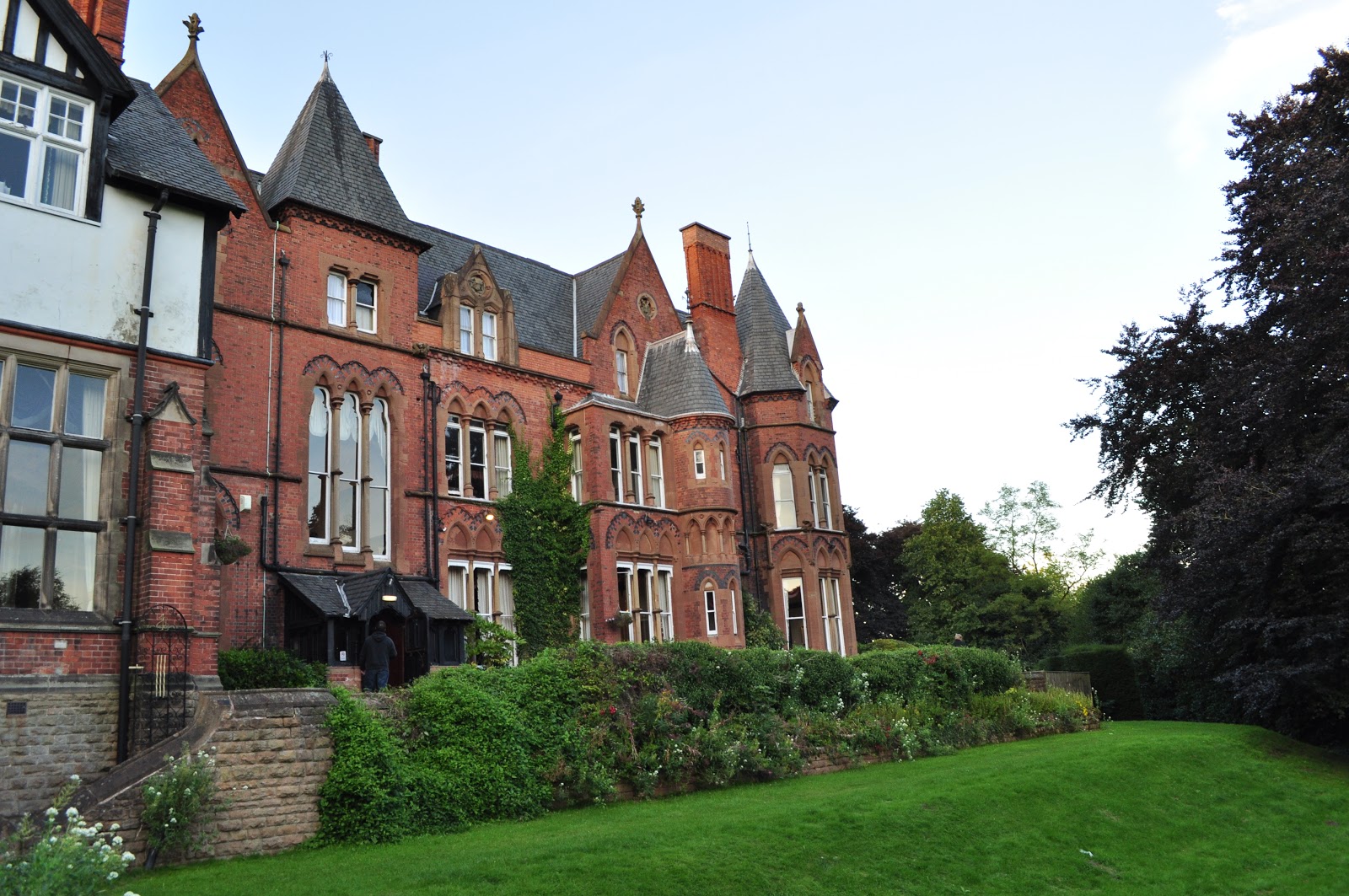
But we did eventually find the place – it was a Best Western, and we were okay with the notion of staying at bland chain hotel that night, since we weren’t going to be in town very long. Instead, though, we came up to a gently restored and modernized 16th century hunting lodge once owned by King Charles II, an absolutely beautiful and slightly foreboding property set in the woods on the north side of town, in a little subdivision called Bestwood. 


Place had a hedge maze in back, and much of the Elizabethan interior was unchanged from historic times. It was a surprise for us – the staff were terrific, the property was quiet and well-kept, the grounds were elegant. After Thornbury Castle (that’s coming up), it was probably the nicest place we bunked in – we were disappointed only in that we didn’t have more time to enjoy it. We wolfed down a hurried dinner outside in the cooling summer evening, by ourselves, headed back to the room and jumped on the internet to get our directions for the ghost hunt. Sharon was in no mood for it – she was exhausted and looking forward to a quiet and uneventful evening, but I pressed her on the ghost gig. This we had to do.  

Had enough yet?