Showing posts with label Nottingham. Show all posts

Saturday, November 28, 2015

Nottingham Pt 2: Old beer,the Cursed Galleon and Medieval Ring-toss

During the course of our 15 minute impromptu car-park chat with Christopher (we talked driving in England, visiting old buildings and life in America), we noted our fondness for old English graveyards -  the churchyards and the Victorian-era municipal cemeteries alike - and our eagerness to explore Church Rock, one of England's best muni's and one that had eluded us on our two prior trips to Nottingham.

We were worried about rain, but Christopher alerted us to another potential peril. Polish gangs, who evidently lurk the cemetery at dusk and at night, sparring over turf (some turf to fight over) and being generally menacing. Evidently part of their trade is illegal cigarettes - not necessarily a surprise, as legal ones are extortionately retailed throughout England.   

The term "Polish gangs" struck an odd note with us, a concept lacking resonance for a couple of American tourists, but it still gave us pause as we looked nervously down at the Nikons swinging at our chests. 

"Sometimes they're in there at night," Christopher noted, "and sometimes the Police chase them out. You'll probably be okay." 

My wallet, brimming with pound notes, was on the nightstand in our room, and I thought, eh, maybe I'll leave it there.

But the cemetery was closed anyway.  

We ambled down a few side streets toward City Centre. At the Market Square there seemed to be some sort of fair in progress - multi-colored lights, rides, vendor stalls - conspicuously sparkly against the grey of the evening and the grimly imposing Council House

What if they gave a fair and no one came? 
But...no people. Was the fair over? Or not yet begun? Had heavy rains earlier chased everyone anyway? A post-apocalypse scene, a Fellini-esque dream fugue? An hallucination?  

We climbed the hill toward the Castle. Normally a tourist magnet, the Castle was closed by this time, and probably little visited on a rainy Monday anyway. 


Nottingham Castle
Our friends at wikipedia tell us that the Castle was built originally by William the Conqueror in 1067, a stronghold to secure his occupation of Mercia, but the structure there now has little material relationship to William's castle. Rebuilt by Henry II, destroyed, re-built, and destroyed again, the original stone foundations dating to the 13th century are visible at ground level, but most of the rest was built in the 17th and 19th centuries, and the castle now stands as a museum and art gallery. 

In the adjacent courtyard,  Robin Hood (this is Nottingham, after all) is poised with bow and arrow at the ready, a few statues of Robin's homies stand nearby. 

'ello, Robin !!


The Trip
The Trip wasn't far from the Castle, just a quarter rotation around Castle Rock. The place was originally carved into the stone as the castle's brewery, the ale hoisted up through a hole in the stone ceiling. 
The ancient Trip - with the ale hoist at the top. 

The place itself is really two distinct dwellings - the timbered Inn, which dates to the mid 1600's, and the inner Inn, carved into the stone and dating to 1189. It is said that Richard the Lionhearted stayed at the Inn on his way to the Third Crusade.


Looking up at the ale hoist.

Our server guy seated us in the old section, a tiny stone-walled room up some steps from the timbered Inn section, a room with barely enough space to seat 10 diners. Various swords and other medievalia adorned the walls, 

Inside the Trip. 
and the legendary Cursed Galleon, draped in dusty cobwebs and enshrined in a glass case, stood on a shelf just over my shoulder. 


Dust me, face yer doom...
It is said that anyone who cleans the thing meets an untimely death - so no one cleans it anymore, and exactly how a ship model can gather dust inside a glass case remains a mystery.   
    
The food was beefy and generous - Glen our server recommended the Abbot's Brown ale, supposedly a recreation of the brown ale served here in medieval times, from the original recipe. It was bitey and a bit heavy, but otherwise nice; something told me it was probably crafted nearer to 21st century palettes than 12th century. I had a couple. Er...maybe three. 

Dinner finished and both of us aled-up, the bartender kindly called us a cab for the two miles back to the hotel. We were tired and it was raining. While we waited, I hung in the main pub area and watched as some locals were testing each other on the Trip's (evidently) renowned bar game: a ring hung from a ceiling chain is swung across the room to catch a hook at the far end of the pub. I don't know if this too had a tradition extending back centuries. Each of the three guys took a couple of turns at it, all to no success. Harder than it looked, I thought to myself. I just watched. One of them turned to me asked it I wanted to "give it a go." 

I shrugged and said ok. Lined up carefully facing the hook, which I could barely see. The image of dart-throwing I had seen in pubs in England - an elegant, gently-focused, simple-motion technique - flashed through my head. Don't fling it, just coax. I let the ring go and - bam - I hung it. First try. 

The three guys were flummoxed-impressed, as was I.  "You've never done this before," the guy said. 

"No, mate, I'm from out of town." 

We high-fived and they bought a round of shots. I got a little sticker-of-honor from the barkeep, who was also suitably impressed. 


After a day of pitiless rain, re-clutching cars, cheating bladder expulsion on the M1, getting lost in Nottingham, puzzling over deserted festivals and dodging scary Polish cigarette contrabandits...a moment of triumph at the Oldest Inn in England.  

Saturday, November 21, 2015

Nottingham Pt 1

One of our 2012 trip's highlights, if you could call it that, was our determined effort to avoid  Swindon, a largely industrial city in the eastern reaches of Wiltshire. (Andy Partridge from the alt-quirk rock band XTC is a life-long Swindonian and something of an erstwhile cultural spokesman there.)

It was on the leg that would take us back to London from Wiltshire, after prowling the neolithic mysteries of Avebury and West Kennet Long Barrow, and the real reason we pasted a skull and crossbones on it was to avoid the Magic Roundabout, a truly malevolent intersection famously regarded as England's scariest place to drive.

Swindon's Magic Roundabout, from a safe distance.
 Avoid it we did.

What we didn't know when we left Watford, emptied of bladder and properly re-clutched with the Mercedes, was that the directions the EuropCar gave us thankfully guided us just past the SECOND scariest to drive in England, the six-circle roundabout at Hemel Hempstead.

At least they have some trees in the center. Hemel Hempstead roundabout.

Neither of us recall him even mentioning it, but had he sent us to the next exit north of Watford to gain access to the M1, this motorist-munching monstrosity awaited.

We didn't discover this bit of good fortune until weeks after we had returned to the States. Half tempted to go back and thank the dude all over again.

We were headed to Nottingham to meet up with our friends from Past Hauntings - Sean, his wife Sarah, his kids and associates - for a ghost hunt somewhere, but the weather was rainy and on the way north Sean texted us that Sarah was ill and they had to cancel for the evening. We had a room booked, so we were going anyway, but we now had the evening free.

The drive into Nottingham - through its inner-ring suburbs and winding, hilly streets - wasn't much fun, and we fumbled through a couple of bad turns before we found the Best Western Westminster (not sure why it was called that, since it was nowhere near Westminster,  a London borough) on Mansfield Road, one of the two or three main thoroughfares through Nottingham.

We had wanted to hit Church Rock Cemetery, the sprawling and vaguely foreboding graveyard right in the middle of town. 

But after dropping off the bags and spending some time chatting in the car park with Christopher, a friendly and slightly disheveled 30ish local who ambled up to us and expressed some interest in our Mercedes, we walked up the road to find that the cemetery was very, very closed, Locked tight. We'd leave that for morning.

Walking to the cemetery....something told me I didn't want to drive thru this.
But I did anyway, the next morning. 
Church Rock Cemetery - the next morning
Instead, a quick check on our GPS indicated that Ye Olde Trip to Jerusalem, the self-proclaimed "oldest inn in Britain" and one of Nottingham's most famous tourist attractions was a mere mile's walk from the hotel. Easy decision; the weather was holding, we were both hungry and in need of sudsy sustenance after a brutal day on England's roads, and we had wanted to see this ancient place for a long time.     

Sunday, July 20, 2014

St Bartholomew in the Trees, the Blind Range Rover and Nottingham

Parish Church of St Batholomew - Maltby
We recently spent some time discussing, or more precisely trying to remember, why the church at Maltby - St Bartholomew's, as it were - ended up on our Conisbrough itinerary. We think it was because we had planned to hit it on our way north to York, on what turned out to be rental-car-snafu day, and it was sort of on the way to the Castle if we were going in that direction, and it just kind of stayed on a list.

Months later, subject to the absurdities of travel blogging nearly a year after the fact, neither of us can be quite sure why we stopped here on the way to Nottingham, but that's the current theory. It has a Saxon tower, and it must have been that feature that landed the place on a list now long lost.

And again, it was just as well we caught the thing heading south, rather than the way north. Had we bothered to look at the church's website - and virtually all active churches, as well as plenty of redundant ones, have websites - we would have found easy directions to the place, but instead we plotted it on a Google map and kind of winged it, in the fairly busy town of Maltby, laced with tourist-befuddling roads and skimpy street signage.

We ended up driving down an alley and turning nose-to-nose up against a broad community garden, the church lurking 100 yards away in the trees on the far side. It made no sense to either of us that the good parishioners of Maltby would traipse across a community garden every Sunday for services, so we pulled out of the alley and tried again.

We eventually found what we believed to be the right road leading to the church, and parked our little Ford at the top, in front of a sad looking Range Rover, missing its headlights and listing with melancholy over a patch of engine oil on the street, and walked down the alley.

The Sad Range Rover and its puddle.

We passed the White Swan, a seventeenth century pub and inn that appeared to be for sale.

Fancy a pint? Meet you at the White Swan...or, maybe not.
It was still for sale when we looked this past May, and frankly we can't tell if it's been re-opened yet or not.

There were a couple of locals chatting in front of a cottage at the bottom of the alley, one of them jumping into his car to leave. We asked the other if this was the proper way to the church.

"It is," he replied somewhat stiffly. "Why do you want to go to the church?"

Well, I stammered, surprised by an otherwise perfectly reasonable question, we're a couple of tourists and we like to photograph old English churches and churchyards. It sounded funny as I said it, and maybe not too persuasive, but my American accent probably validated the story. Why else would a couple of Americans be here? I was ready to show him our Nikons if he pressed us further, as silly as that would have been, but he didn't.

Would you like to see the inside?

Yes indeed.

My wife's the church warden - I'll fetch her and she can open the church for you.

Her name was Pam - we sadly didn't get her husband's name - and she came and opened the church for us. The church is largely Victorian, built on the site of a medieval church and including various memorials from earlier times,
Early 18th century memorial - Parish Church of St Bartholomew - Maltby


Parish Church of St Batholomew - Maltby

Parish Church of St Batholomew - Maltby
and yes, the tower is obviously much older than the rest of the structure.

Saxon tower - Parish Church of St Batholomew - Maltby
Pam was gracious and more than a little flattered that someone had come all the way from the States to see and photograph their humble little church; which, of course, wasn't exactly the case, she should have been flattered that it ended up on a list, and we can only be glad that she isn't quizzing us now as to why, because (as we admitted earlier) we really don't know why.

Her husband explained a bit about the post-war renovations that the church had undergone,


including some workman finding bones beneath the structure while they were working on modernizing the heating system; medieval burials, undoubtedly. Saxon? Norman? No one knew.

Bathed in yellow light, cast against the now-fading evening light outside, the church, while not itself particularly historic, beamed with a weird kind of haunting glow.
Parish Church of St Bartholomew - Maltby
The churchyard, set in a tight and darkened grove of trees, was especially atmospheric.

Churchyard - Parish Church of St Bartholomew, Maltby
The church sits in a little valley bisected by a stream, and evidently there was a prolonged disagreement in medieval times between neighboring parishes which side the church should sit on, presumably in a time when the stream was more of an obstacle to cross (we barely noticed it). Anyway, they settled on that side of the stream, and no one knows why.

Another local, an older gentleman wearing a beret, came strolling across the church grounds with his two dogs as we were leaving the church. The churchwarden's husband promptly asked us to not let the dogs in, but one of them snuck in anyway and we spent a minute or two chasing him around the empty pews. We chatted a bit with the older gentleman as we shot the churchyard, telling him we really enjoyed visiting the old churches. "You've certainly come to the right country," he said.

Getting out of Maltby wasn't much easier than getting around it, and we were both pretty whipped. We found our way back to the A1 and made for Nottingham.

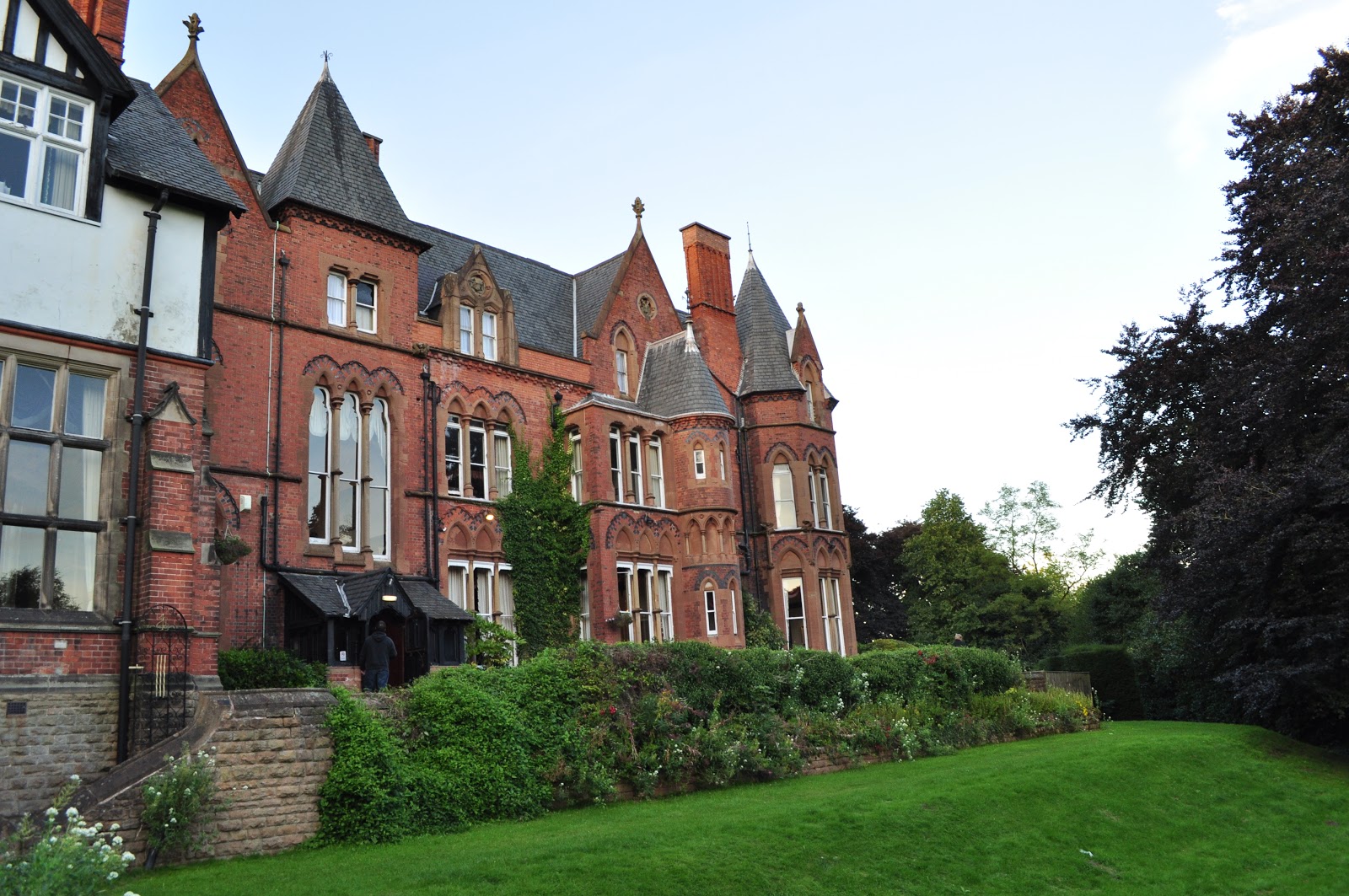
There was a wedding reception in full throttle at the Bestwood Lodge when we pulled in, and we had to settle for a parking space some distance from the hotel itself. We spent a night at this place last year, and we liked it - the site dates to the fourteenth century when a hunting lodge was first constructed for King Edward III, although the current structure is Victorian. The place is surrounded by forest land - and no, not Sherwood Forest, which is most commonly associated with Nottingham.

We lugged the bags past the flashing lights and pounding dance music exploding from one of the side bars, and came up to the front desk. To our dismay, we learned that they had moved our reservation to one of the "back rooms", presumably to accommodate wedding guests reconsidering their plan to weave home after the gala. I was too tired to argue with the front desk girl. I think Sharon wanted to make a bit of a stink, but I figured we were only there for two nights. So what.

The room was actually a bit of a disappointment, a healthy hike from the only hotel entrance, a bit cramped and at least a travel-site star less than the one we had in 2012. I suppose we had grown a little picky about hotel rooms by this time; the place wasn't exactly cheap, and since they had downgraded our room, we wondered if they should have offered us a partial refund. They didn't, and it's too late to ask now. 

We got up there, dumped some bags and trudged back to the car for more, past the lights and music and wobbly reception guests.

The bar in the main hotel room was open, though, so after squeezing our stuff into the room we went downstairs, ordered a couple of ciders and sandwiches, and ate dinner in the fading summer twilight outside on the terrace.
The reception was just barely within earshot, and from time to time one of the tanked-up guests would stagger across the grass nearby, but other than that we had the terrace quietly to ourselves, a bit of unwind-time we both needed.

Our plan for the next day was to meet our friends from Past Hauntings at a heritage site in Derbyshire, maybe 14 miles away, around late morning. That meant we could sleep in.


Wednesday, December 26, 2012

Chasing ghosts - Nottingham


We hurried back inside after our dinner and I checked the email. The guys asked us to meet them at Annesley Hall, a ruined medieval manor house owned for centuries by the Chaworth family. (Mary Chaworth was the boyhood lover of Lord Byron). The place – a sprawling estate with a ruined Norman-era chapel, churchyard and stables on the grounds - was now in private hands, with estimates for its restoration at something like 20 million GBP. We were told that the Nottingham county government had wanted to purchase and open the place as a tourist attraction, but the owner wouldn't sell, evidently preferring to just sit on it.

Ghost hunting groups often have a weird vibe about outsiders; in the States, there is an undeniable undercurrent of competition amongst groups for outside media coverage and the usually limited availability of credible investigation sites, while the pool of amateur ghost hunters (and, technically, there’s no such thing as a professional group, for reasons which should be obvious) has exploded due the popularity of a ceaseless parade of reality TV shows around ghost hunting. There’s also a kind fraternal element to the subculture – groups pride themselves on the currency of their equipment and the quality of their evidence, exuding the same kind of pride you might find amongst classic car owners showing their rebuilt muscle cars, trading notes on parts and 0-60 strip timings.

But the bunch we hooked up with, who call themselves PAST Hauntings, were warm and welcoming to us.

Their directions in the email were a bit sketchy – no problem, I thought, we’d just look the place up on Google and pipe the directions into the GPS. Ah, but not so simple, since there were three or four properties in the area with the name "Annesley", so we kind of took the written instructions and triangulated against Google and figured we’d find it. And we kind of did, although we waited on a lonely dead end street for 20 minutes until climbing back into the car and prowling around a bit more until we found the right street.

Sean was the group’s leader, a stout, enthusiastic bloke of about 40, a Nottingham cabbie by day and longtime ghost hunter. His tech guy was Simon, who worked at a local casino (we didn't know that there were any casinos in England), and Sean’s daughter Sian and a younger fellow Ashley were also along, all piled in Sean’s tiny hatchback with a few suitcases of equipment.

We deployed the digitalia and spent a couple of hours walking around the ruined chapel, dodging and occasionally tripping over 18th century headstones, and outside the fence of the estate itself, as well as shooting pictures and doing some recordings down at the stable. Ghost hunting, especially in a group, tends not to be very spooky (at least not for us, anyway), since you're usually focused on team management and equipment, and a lot of the time we spent at Annesley was exchanging  notes with the group on English ghost hunting and sharing commentary on the current state of para-TV. But Sharon and I, after some years of stomping around private B&B’s and mansions in the US, couldn't resist  a palpable rush of excitement prowling around a centuries-old churchyard and manor grounds in England.
We caught one interesting piece of still photo evidence, shot through an open window in the stables:


We're cautiously writing off this unusual image as the flash-illuminated image of some cobwebs in front of the camera, although we'll concede we've never caught anything quite like it before. 

Also, in addition to one decidedly peculiar piece of audio captured on my video camera, below (the voice at the end of the clip, which sounds French to our ears, was not from anyone in the group - I know a little bit, strands and fragments from French class in high school almost forty years ago that I'm generally not predisposed to showing off to anyone, and no one else in the group knew any at all):


But later, I did witness what in even my most cautious estimate was probably something of note; down at the stables, against the dimly lit and 60-yard distant walls of the estate itself, I saw what looked a lot like a growing black mass, a cloudlike apparition that obscured the building across the courtyard. It only last a few seconds, but it was enough for me to exclaim “Holy crap, did you see that?” to Sean who was standing at my side at the time. “I did,” he said, almost matter-of-fact. “Yeah, people see that a lot here.” There was a dim veil of ambient light from some distant streetlamps, as well as occasional brightening and darkening from the very light traffic along that street, maybe a mile distant, but what I saw was definitely not a product of ambient light. 


An English ghost? Well, maybe…in any case, my camcorder wasn't running at the time (sounds a little odd, but despite the usual battery of devices and cameras usually deployed at one of these ghost hunts, a lot what does happen isn't captured on anything, for a variety of reasons...), and it may not have recorded the apparition anyway, since even with an add-on IR light, the camcorder is fairly feeble in low-light outdoor settings. But I have no doubt I actually saw it. We've been on several dozen no-evidence investigations, but this struck me as something like The Real Deal. We've got a post up on our other blog about the Annesley Hall investigation, here.


After a couple of hours, we piled into the cars (I told them I'd follow, making them promise not to lose me along the way, since we had no idea where we were going) and made our way over to Colwick Old Church, another ruined church (there were small trees growing within its roofless walls) and churchyard on the south side of Nottingham, and walked around there for an hour and a half, shooting pictures and running the voice recorder. There are stories about the sighting of a Lady in White who is seen breezing her way through the cemetery, thought to be the spirit of a certain Mrs. Saville, who was murdered by an enraged husband in the nearby woods in 1844. There is also the grave site of an Elizabeth Swinscoe, d.1777... 


with whom the PAST guys have had a number of interesting EMF Q&A sessions in past. We didn't capture or witness anything extraordinary at Elizabeth's grave, apart from admiring the truly amazing (though broken and repaired) headstone bearing her name. I had a couple of fleeting but notable hits on the MEL meter nearby the grave, but nothing corroborating the EMF spikes.  

At about 1 AM, we all decided to call it a night – we punched up the hotel on the GPS, thanked the group and headed back to Bestwood. Nottingham streets were all but deserted by this time; along Mansfield Road we drove by the famed Rock Cemetery, the old (1840’s) city cemetery at the north end of downtown Nottingham. This had been one of our target graveyards for the trip, we had been hoping to get into Nottingham early enough the day before to visit and shoot it, but a view from the car window, at 2 in the morning, was all we were going to get out of it. We had a lot of driving awaiting us the next day, with no time to drive back into downtown in the morning (to say nothing of finding a place to park, which we were told is a challenge), and we were looking at next to no sleep.

Back at the hotel, we decided to grab a nightcap. (There's always time for that.) The bar, we'd been told, was open 24hrs/day, but we had to find the night watchman to actually fix us a drink, which we sipped at a table in the front courtyard in the stillness of an early weekday morning. We finally got up to the room and dropped off into exhausted sleep around 2:15 AM, wrapping up what was a ridiculously ambitious but successful day. 

Shropshire and the West Midlands was next.  

Sunday, November 25, 2012

York to Nottingham, the long way


Driving day again, we woke up a little hazy from the night before. I took a quick shower, we packed up and checked out of the hotel. 

The car was lodged into a maddeningly tight parking space, and despite my best 7-point turn, I couldn't seem to get the thing out. A guy exiting the gym came up to my window and offered in a crisp Eastern European accent to dislodge the VW for me – I was a little embarrassed that my de-parking skills had elicited the charity of strangers, but the guy smiled and said he parked cars for a living and this was a no-brainer for him, and he understood that American tourists had a little trouble with the tight spaces. I never really got comfortable with that car. Or most parking lots, for that matter. Car parks, as they say.

We were off to Nottingham. We had contacted a local ghost-hunting team over the Internet months before and they offered to take us out for an investigation. I was excited by the prospect. This whole trip was, after all, the Dead Englishmen Tour, and tonight promised to be dead guys up close, in the dark. Rock Cemetery, the city's oldest municipal burying ground, also looked promising, but I had some doubt we'd have time to see it.

Nottingham is south of York, a couple of hours if you take the fast way, but instead we headed north toward Rievaulx Abbey, Byland Abbey and Helmsley Castle. This was going to be one of our longest driving days; I tried as best I could to re-steel my road nerves, which had slackened the previous day walking around York.
We hopped on the B1363 and headed north out of town. 

Along the way, we came upon Gilling East, an historic and quiet village considered something of a York exurb. We had made no prior plans to stop there, but I spied the church on the main drag, pulled the car off the road and parked. The spontaneity thing again; in earlier years, I had found myself in periods of lethal boredom watching Rick Steves travel programs on PBS, at a time when a trip to Europe was as likely for me as a trip to Mars, but one thing I did take away from them was his unerringly emphatic tip to stop at unplanned places and just walk around. You can’t do that on a bus tour, and I figured this soft morning in Yorkshire was as good a time as any to liberate my Inner Steves. 

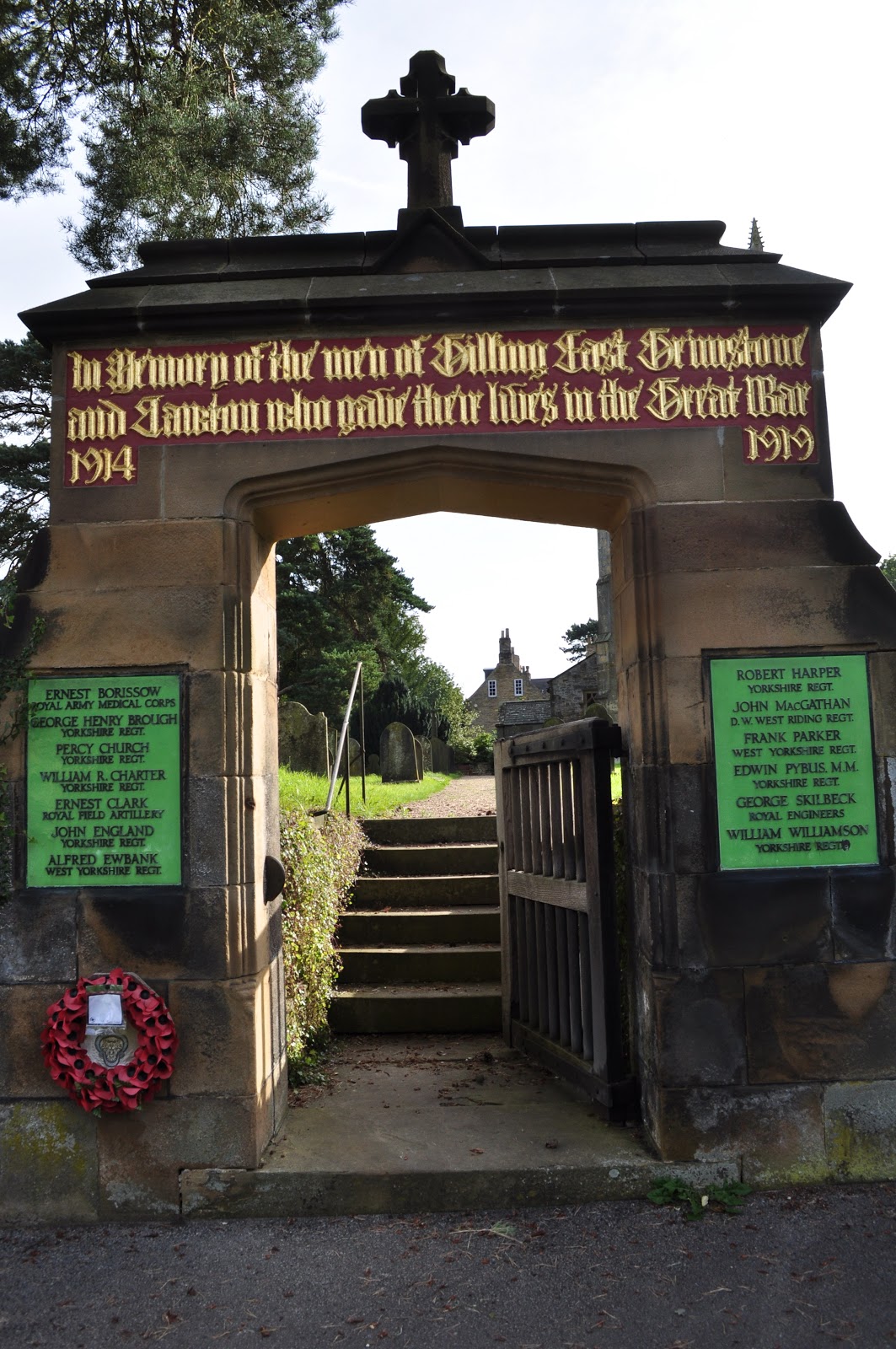
A nice lady visiting the church, a local, said hello to us as we entered the churchyard of Holy Cross. She seemed pleased we had stopped to visit, asked where we were headed (“ah, so you’re going north, to go to Nottingham,” she noted dryly) and invited us to go inside. At the entrance to the churchyard stood an immense and ornate memorial archway dedicated to the area’s fallen WW1 soldiers; WW1 memorials are a common site everywhere in England, a reminder of the generation-rending scars England still bears from that war, now almost a century ago.


The church itself was fascinating, dating to pre-Norman times and including the tomb of an unknown knight in the sanctuary. The visitor’s sign indicated he may have been the church’s founder, but the age and identity of the sarcophagus is known only to history. 


The church also housed the tombs of Sir Nicholas Fairfax, 3 times High Sheriff of Yorkshire in the 16th century and something of a heroic figure in challenging Henry VIII's pogrom against the Catholic establishment, and his two wives.  


Here's a bit we found (after the fact) about Fairfax. 
In Oct of the same year a rising took place in Lincolnshire and 6 days later the rising in Yorkshire began with a great assembly in the East Riding. Fairfax was one of the Yorkshire gentlemen who received a letter from King Henry VIII commanding him to aid in repressing "certain traitors" and "suffer by dint and sword or else so yield that the ringleaders be committed to prison" to await trial. But Sir Nicholas was more inclined to join the "traitors" than to obey the King’s command. Sir Thomas Percy sent for Sir Nicholas Fairfax to attend a muster of 10,000 men at Malton. 
William Stapleton, in his account of the rebellion, says that on Saturday 21st Oct he came to York and heard how Sir Thomas Percy and Sir Nicholas Fayerfax, with the Abbot of St. Mary’s York, had gone to Pontefract (Pomfret) with a goodly band the same day. Meanwhile the Duke of Norfolk was marching north against the rebels. It was obvious that the Duke was inclined to be lenient and begged that King not to reprimand him for any concessions he might make. However, on reaching Doncaster he met a deputation from Pomfret. It would appear that Norfolk was persuaded that he had the inferior force and on 27th Oct an agreement was made, the King’s pardon published and the rebels were dismissed to their homes. The King however demanded 10 ringleaders to be delivered to him.
Fairfax, notwithstanding their promise to the King, moved that the parishes of Dent and Sedbar might rise and raise both Lancashire and Cheshire. It was decided to rally the Abbots of the Yorkshire Abbeys, remembering that Gilling Church had been given to St. Mary’s Abbey, York many years before. On Dec 2nd the rebels held a gathering of lords, laymen, and clergy; the Archbishop of York preached. Among them were Sir Nicholas Fairfax, Sir William Fairfax of Steeton, Sir George Darcy (Nicholas’s brother-in-law), Sir Henry Gascoyne (Sir Nicholas’s cousin), and Mr Palmes (perhaps a cousin of Sir Nicholas’s wife). At this meeting they accepted the granting of a full pardon but no conditions as to the arrest of ringleaders. Sir Nicholas succeeded in making his peace with the King and was pardoned on 18th Jan 1537. He took no further part in a subsequent abortive rebellion: he had had enough.
The connection to St Mary's Abbey was a coincidence (we had just walked around the place the day before) that we were unaware of until after we got home. You can walk around and photograph the history, or you can bury yourself in it; thankfully, there's plenty in between. Gilling East was a small place, not necessarily on any tourist-guide must-see lists, but if we go back to Yorkshire, I'd like to see it again.


Helmsley Castle was next. 


Built by Robert de Ros in the late 12th century, the castle is one of many in the care of English Heritage, although it is privately owned. Most of the fortifications are in ruins, having suffered significant damage during the English Civil War (c. 1640’s), although the manor house and apartment buildings are in good shape, and some of the 15th century rooms are still intact with original wood furnishings and trim.


The place was intriguing; our first real exposure to mostly-intact medieval interiors (apart from the churches), and it took some time to see the whole facility. There was a light scattering of fellow visitors as well. Ruined castles play tricks on your sense of time and space – large open areas, laced with occasional exposure of foundation, peripherally marked by large and irregularly ruined keeps or houses, usually from different eras and betraying different building styles. 


Your mind wants to associate them all to a single notch on history’s timeline, but it’s actually a little more like stratography, where you’re seeing the passage of centuries, a sequence of building and destruction, re-building, remodeling, neglect and restoration. The reality is that you have to de-compress the centuries and understand these sites as processes. Just because what you see is hundreds of years old doesn’t mean it existed whole at any one time.  It challenges a two dimensional view of these sites, and all the large historical ruins we visited were like this.


A massive Cistercian ruin, once one of the largest and most prosperous Cistercian Abbeys in all of England, this enormous mission was established in 1132 and fell to ruin at the hands of Henry VIII in 1538, and is considered second only to Fountains Abbey in renown. The place absolutely dwarfs the ruin at Whitby which we saw two days earlier, and is far larger than the view we got from the road that day.

Many of the ruined abbeys were scavenged for their stone by neighboring villages (much of the lead and other metals were plundered by Henry’s troops), but Rievaulx stands far less pillaged than many of the others in part due to its location deep in a river valley in North Yorkshire – it was simply too difficult for  the area villagers to remove the massive stone blocks up the steep banks of the valley. The road in was by far the steepest and one of the narrowest we drove the entire two weeks in England.

Rievaulx is a shattering experience up close. The monks working this property diverted the river Rye three times out to accommodate their building projects, and they also built a prototype blast furnace at nearby Laskill, producing smelted metals of refinement far beyond anything else being produced at the time. It has been said that the closure and dispersion of the Rievaulx mission delayed the onset of the Industrial Revolution by two and a half centuries.

The church columns and arches are largely intact, and the chapterhouse, dormitories and other buildings are at the very least well defined around the church itself. In some respects, it is a difficult place to photograph; the scale and breadth of the place is absolutely vital to the experience. 


A nearby building features an exhibit of the life of the Cistercian monks, and a tiny village adjoining the abbey property – thatched roofed cottages with satellite dishes and Range Rovers out front – summons a slightly airbrushed resonance of medieval life outside this massive religious site. Walking through the abbey itself, you hear almost nothing except the bleats and moos of nearby livestock. Rievaulx is haunting, intimidating, compelling. At the risk of overstating it, any tourist traveling the North Yorkshire countryside would be out of his mind to miss this place.  
      
 Byland was next. Another Cistercian ruin, only 5 miles away as the crow flies, and a very impressive place. A good deal less of the primary buildings remain at Byland, giving it the impression of being smaller than Rievaulx, when in fact the site is actually larger by land area. Byland also has one of the most extensive collections of in-situ medieval tile work anywhere in Europe. 


It felt different from Rievaulx – less overtly compelling, the space being less well defined, the connection to the past more tenuous. The tile work isn’t really fenced off, although there are signs requesting visitors not to step on them. The cemetery lays behind the church itself, although you’d only know if you looked at a site map – it’s just a grassy field. Byland is a less well-known site than Rievaulx (and much less than the famous Fountains Abbey, also in Yorkshire but not on the itinerary for us, for reasons owing as much to planning neglect on our part as anything else) and it is visited less than Rievaulx, while only being a fifteen minute drive away. Its charms were more subtle than Rievaulx or Whitby, but a beautiful and haunting place nonetheless. 

Three large outdoor ruins in quick succession; it was early afternoon and I was beat already. I had it in my mind that we’d go crawling around on our way south to Nottingham to find more villages and churchyards, but the clock was escaping us and we had a group to meet somewhere (we didn’t know where yet) in Nottingham, a good hundred miles or so to the south. So after a fun and slightly weird conversation with the lady at the entrance office, and laying out for a little tourist swag, we climbed in the VW, made our way west toward Thirsk, stopping off at one church along the way. A minor indulgence at my request; All Saints Church, at Kirby Hill. The name is actually fairly common in Yorkshire, and a little digging suggests it is derived from the old English (or Norse) word for "church". 


We shot the cemetery (the church was locked) and then blasted down the A1, one of Britain’s superhighways, clutching the slow lane as trucks and Mercedes’ passed us at autobahn-worthy speeds. By this time, I was grateful for highway driving – no roundabouts, no tricky off-camber turns. Just find the slowest guy and get behind him. I don’t think I actually passed anyone until Day 8.

Nottingham, of course, is well associated with Robin Hood (who may or may not have even existed), and Sherwood Forest. What’s left of the forest is a protected park, we saw signs for it along the highway as we approached Nottingham, as well Robin Hood this and Robin Hood that. There’s an undeniable allure to the legend, especially to anyone even mildly sympathetic to the notion of fleecing the rich on behalf of the working class, but we really had little interest in seeing the Robin Hood exhibiture. And exhausted from a long day, I managed to get us lost off the highway on the way to the hotel. GPS, my ass – I can get us lost anywhere. Here, watch this drive.

But we did eventually find the place – it was a Best Western, and we were okay with the notion of staying at bland chain hotel that night, since we weren’t going to be in town very long. Instead, though, we came up to a gently restored and modernized 16th century hunting lodge once owned by King Charles II, an absolutely beautiful and slightly foreboding property set in the woods on the north side of town, in a little subdivision called Bestwood. 


Place had a hedge maze in back, and much of the Elizabethan interior was unchanged from historic times. It was a surprise for us – the staff were terrific, the property was quiet and well-kept, the grounds were elegant. After Thornbury Castle (that’s coming up), it was probably the nicest place we bunked in – we were disappointed only in that we didn’t have more time to enjoy it. We wolfed down a hurried dinner outside in the cooling summer evening, by ourselves, headed back to the room and jumped on the internet to get our directions for the ghost hunt. Sharon was in no mood for it – she was exhausted and looking forward to a quiet and uneventful evening, but I pressed her on the ghost gig. This we had to do.  

Had enough yet?