If you don’t like standing in line, the ruins of Muchelney Abbey won’t disappoint you.
Apart
from the Abbot’s House, which still retains a fair amount of Norman building
fabric and throughout which is scattered various bits of recovered carved
masonry from the now-vanished Abbey, there is little left of what was once a
fairly extensive facility whose history dates to the late seventh century. We
liked the place, but could easily see how tourists, especially if they were
coming from the poetic magnificence of Glastonbury, not far to the north, would
find Muchelney a subdued diversion.
The
Abbey foundations lay at soil-level in a grid that really only reveals itself
from the air;

almost nothing remains higher than the visitor’s shinbone.
I felt the same kind of melancholy I first experienced at Hailes Abbey, this
vague sense of a sacred space defined in skeletal minimalism, a silent and nearly dissolved ghost whose frame is really only appreciated from above, a place that
has resigned itself to no longer coaxing the mental image of an actual building.

At the
northern end of the Abbey site, we found a number of opened stone sarcophagi –
the long-since emptied resting places of clerics, we imagined, looking a little
like aliens’ coffins.

But
beyond that lay The Church of St Peter and Paul, the parish church for the tiny
Muchelney community and a staggeringly old building, with a fair amount of
building fabric dating to Saxon times (pre-mid 11th century). As it
was outside the Abbey property, we said goodbye to Dennis and walked around to
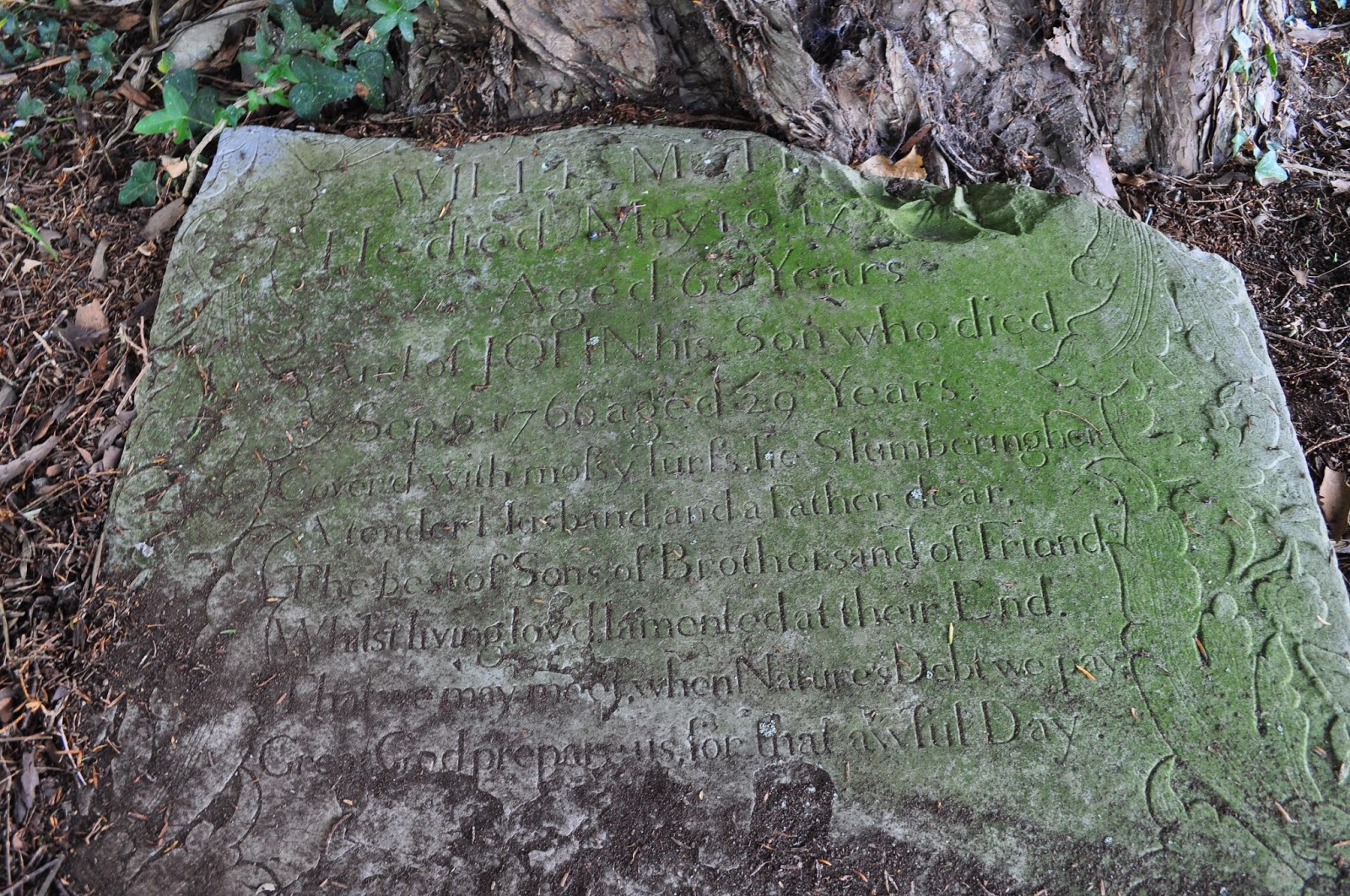
the church. The churchyard was laden was
sullen, moss-speckled 18th and 19th century monuments,
some collapsed graves and more stone sarcophagi, a palpably affecting place
shrouded in the vestiges of ancient grief.


Inside, the church was deathly
quiet, decorated in places with carved masonry recovered from the Abbey, bands of
early afternoon light streaming weakly through the stained glass.
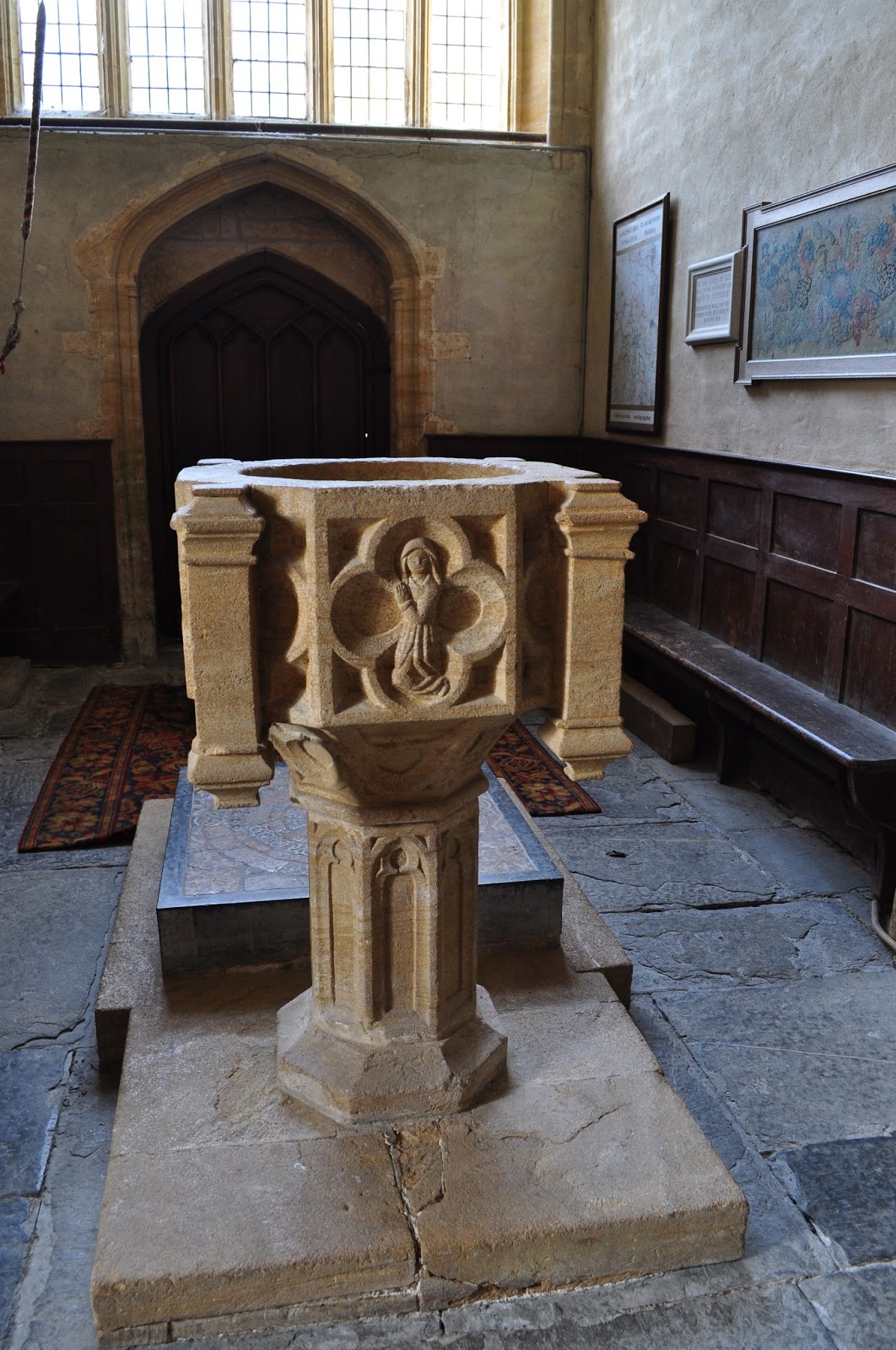


This is working
parish church, like many of the others we saw, but it felt like a great tomb.
We loved it.
On the
road again.
Had we
wanted at this point to take in one of England’s great abbey ruins, we could
have headed north a mere four miles or so and visited Glastonbury, but like a
number of other famous sites we found ourselves in relatively close proximity
to, we just passed on it and headed east, running into Northover and stopping
off at St Andrew’s ..


…then
another unscheduled stop at another St Andrew’s, in the village of Holcombe. We
spent maybe 10 minutes here: the church was locked, and a side door was covered
in spider webs. A somewhat gloomy place, Sharon didn’t like it all, barely
snapping a few pictures in the churchyard before urging me back to the car.


The next
stop, also unscheduled, was another CCT property, St Mary’s Hardington Bampfylde,


a Norman era church in the village of Laverton, adorned with some gentle
Victorian restoration, swatches of Norman wall paintings still visible and some
impressive memorials. We both enjoyed this church very much and spent almost an
hour inside – again, with no one else present.
Months
ago, as we were recalling our trip through Shrewsbury, we attempted to derive
some order and predictability as to when and where we were likely to find
churches unlocked. Since then, as we began to research our Dead Englishmen Tour
Part 2 (yes, it’s coming up, maybe seven weeks off at this point in time) , we
came across Simon Knott’s two incredible websites devoted to Norfolk and
Suffolk churches.
Knott, who lives in Suffolk, has documented virtually every church
in East Anglia with photographs and descriptions of each – something north of 1500
in all, including ruined churches and completely vanished ones, represented in
most cases by pictures of empty fields – and in his writing, he is not shy
about venting frustration over churches that are kept locked. Knott’s
perspective as a church-obsessive and a Suffolk native probably gives him
greater standing in his complaints about locked churches than do a couple of
Nikon-slinging American tourists (I dropped him an email about his website and
asked for some recommendations, as we were planning to spend the last leg of
this year’s trip in Suffolk, but he never replied – he gets a lot of mail, I
guess. That, or my puny and standard issue tourist entreaties weren’t worth the
trouble to reply to. No harm – I still enjoy his twin sites very much. )
What I
have learned from reading several hundred of his entries over the past few
months is that churches are kept locked for any number of reasons – suspicion of
outsiders and their motives, a recent history of vandalism, structural peril, inaccessibility
(and thus, vulnerability) of the churches themselves, or reasons known only to
the local rector or parish council. Which, in the final analysis, was more or
less what we thought all along. Some are kept locked, some aren’t, and the
locked ones are locked for a reason, some reason, and that’s that.
Maybe we’d
have a stronger opinion on the matter if we lived there, or were, in Knott’s
words, “pilgrims in need of periodic spiritual refreshment”, but we don’t live
there and seldom thirst for spiritual refreshment, and I think we’re just fine
with letting the locals decide themselves whether or not to keep their churches
locked. They have their reasons, we’ll leave it up to folks like Mr Knott to
judge whether they are valid or not.
But
looking back, we were actually pretty lucky. Some of that is due to the fact
that many of the churches we visited were in the care of the CCT, and part of
their mission is to keep historic churches accessible to the public. We’ll let
you know how we fare on the DET2.
Four
churches and an abbey, and the skies were turning grey again. Time to hit our
last hotel, the charmingly named Lion and Fiddle, in the crossroads town of
Hilperton. Yes…where???
There
isn’t much reason to visit Hilperton, and we don’t mean that in a snotty,
tourist-ennui sort of way.
At some point, we had it in our heads that we’d stay
here because of its proximity to Bath, one of England’s real treasure cities
and a tourist favorite, but Bath is west and a pretty big place, and we still
had Avebury and Lacock on the itinerary, both east and on the way back to
London, and we couldn’t do both. Neither the prospect of driving into Bath
(which is generally not recommended), or stopping outside and catching a bus or
shuttle (which would have been logistically challenging and a time sink)
appealed to us very much, so we decided instead to just have a relaxed evening
in Hilperton and an unhurried morning, and head east.
The
barkeep, who turned out to be owner’s son, let us into our room, a
spectacularly unspectacular accommodation and a pleasing chaser after the regal
cush we had (and enjoyed) at Thornbury. Just a little room, clean and
utilitarian, overlooking a playground and the hotel’s car park. Some folks get
a taste of lofty luxury and want more; we got a taste of it and were grateful
for less. It wasn’t a money thing – we just wanted to feel normal again.


We
dropped off bags and met the loo, and headed back downstairs for a smoke. There
was a wedding reception in progress – or, maybe just wrapping up. The large
dining room was completely empty, with ear-splitting hip hop music slamming
forth from an unattended DJ station into a room of empty tables. We went out to
the patio area, and in a minute or two, a skinny, tattooed woman in her late
thirties in a wedding gown (well, not exactly a gown, but clearly a
bride’s costume) and sporting a bit of a sozzle came out with what appeared to
be her Dad. She smiled shyly at us; I congratulated her (guessing correctly
that she was the bride), and she thanked us. We spent a few minutes talking
about the weather to her Dad as she disappeared again, the hip hop continued to
play to no guests whatsoever, and I remember wondering if people in
England often got married on Tuesdays.
It
started to rain.
We weren’t
sure, but the pub at the Lion and Fiddle struck as the only watering hole in
town, and as we seated for dinner, a decent stream of locals – a single bloke
or two, a couple of families – came in to watch the soccer game on the big
screen, some drinking and some having dinner. It felt like a community pub,
which sounds kind of trite but not all pubs felt like that to us. Fish and
chips, a steak sandwich, a couple of ales and we were pretty well finished for
the day. We went upstairs, flipped on the tiny TV and konked out. Our last day
with the car was tomorrow, including the one piece I had almost forgotten to
worry about: driving back into London to the rental car office.
Oh yeah…that.


