Sitting out in the grassy beer garden beside the Old Malt
Sccop in Lapford, rural Devon. Overcast, fairly cool.Our first morning here, 7 days into England 2019.
I should have gotten my hoody, but Sharon is still sleeping, or semi sleeping, since
I made some noise trying to get out of the room,
The cattle are honking at the
farm next door, the sheep are grazing peacefully 100 yards away. A light rain
just now chased me onto the patio, semi-covered.
The pace has been fast, so this is the first chance I’ve had
to scribble some notes. We’ve done somewhere north of 1300 miles so far, and we’ve
done pretty well hitting sites. A few missed due to time or distance, or simply
choice, but overall we’ve done well.
The driving has been exhausting, especially the medium sized
towns where the roads get tangled and the GPS gets confused, which has happened
more often than I remember from past trips.
Today is Exeter, at least at this point that’s the plan, and
we’ll be taking the bus.
The hotel here is a pretty nice facility – an obvious
community drinking spot, appears to be part old coaching inn and part reformed
farm house. Already chatted up with some locals – where are we from, dogs,
travel logistics – and everyone is friendly, and a little curious. I’m not sure
many Yanks find and stay at this place. It’s pretty much in the middle of
nowhere.
Watched the Netflix doc about the Fyre Festival last night - a few thoughts come to mind.
Plenty of schadenfreude has been slung around about instagram-hypnotized scenester millennials dispensing thousands of piasters (in some cases, 10's or 100's of thousands) to attend a completely implausible music festival in the Bahamas, goaded on by clever social media marketing images of slow-mo super models splashing around on a pristine Caribbean beach and winking suggestively over their mai-tais.
And frankly, yeah, it's a struggle not to giggle at the dissolving whoosh of hipsters' bored money into a bottomless black hole.
But really, c'mon, there have been scams as long as there have been people (in the interests of full disclosure, I fell for one myself, more than thirty years ago), and this one - although cinematic in its sweep and audaciously catastrophic in its finale - is really just another in the proud tradition of lying for cash.
Someone said The Dream was this way
We have little sympathy for the scammed in this case, a lot more for the locals who worked their tails off futilely, didn't get paid and probably don't have trust funds backing up their dubious life choices, but as for whether or not this is a deeper commentary on a social-media driven society where image in everything, the fact is that illusion is ALWAYS the central component of a scam. Social media is a just a firehose for the bullshit.
The other thought is that music festivals (which I personally have no beef against - they can be fun, community enriching and socially bonding events) are extremely hard work to pull off, and the prevailing notion proposed by the chief perpetrator (and current ward of the Federal Corrections facility in Otisville, NY) of this comic dumpster fyre (Billy McFarland) that a positive attitude and dedicated team work will overcome the basic logistics of payroll, crowd management and resource control was, for me, maybe the most infuriating part of this event. I know the guys who do the Arise Festival in Loveland, and they work their asses off every year to put this event on. Counting porta-potties and measuring chain-link fencing isn't as sexay-time as filming models splashing gleefully around in turquoise waters.
Lastly, I still appreciate Trevor Noah's commentary on Fyre: "Yeah. White people love camping...unless it's a surprise."
Two years and change since our last installment here, and on the last day of 2018, we woke up this morning thinking that, for some strange reason, this would be a good time to dust off the old blog and start gnawing pointlessly away at the bandwidth again.
It'd be a bit pointless to "get all caught up", as it were, since a lot has happened since our last attempt to revive this enterprise. We completed another trip to the UK last year - in 2017 - and we'll start planning this year's trip in a few months. Southwest, with another few days up in York again. We've already marked off a few spots, and will start a 2019 map soon.
Donald Trump is still president - not feeling much like commenting on that at the moment, but we likely will if we keep this going. Suffice to say, it's been as stupid, chaotic, troubling and destructive as a lot of us feared, and most observers think this will be a monumentally important year in the Worst Reality Show Presidency Ever.
For now, I'm shaking off a night of vacation-grade sleep, watching the temperature dropping into the low teens under gloomy morning skies, and trying to reconcile the fact that a 12 day stretch of vacation is ending after tomorrow. I'm mostly okay with it, resisting my usual regret that I didn't do everything I had hope to do with all the time off. I find myself increasingly focused on my management of time. I turned 60 last April - I suppose this is a logical consequence.
Anyway...hi again, and let's see what 2019 has to offer.
As is probably common for featherweight bloggers, our 2015 UK trip blog dissolved into the dark swamp of Real Life distractions and uncertainties about the way forward. No excuses.
So we are left with two daunting issues - the first being that the 2015 UK trip is fading from memory (well, the little day to day stuff that we like to include), and the second being that we've actually gone BACK to the UK since then, for a whole other two week adventure.
So do we struggle through 2015 and start up 2016? Do them both in a maddeningly random, chronologically entangled manner, just do 2016? Give up completely?
We'll land on one square or another shortly. We will. Honest. Too much good stuff from both to walk away...so there, we've already dispensed with the 'Give up completely' option. Progress.
When we chatted with Christopher, our chance encounter friend outside the hotel in Nottingham, he asked us casually where we were headed next. We told him we had two nights booked up in Tirill. He didn't know where that was.
"Just outside of Penrith," I said.
He didn't know where that was, either.
Our choice of lodging for the Cumbria leg, the Queen's Head in Tirill,
Queen's Head - Tirill
was merely a function of geography and proximity. Furness Abbey, one of the great monastic sites in Britain, had been on my list since our first trip in 2012, but it was located inconveniently in the extreme northwest of the country. We found Tirill by just doing a scan of little villages that would put us within striking distance of Furness and a clutch of castles in the area. There wasn't much in the way of lodging, until we looked deeper in the Lake District, where the accommodations became more expensive and more obviously biased toward caravan (RV) parks and holiday cottages - not our thing.
Tirill is actually one of three villages - the other two being Stockbridge and Thorpe - which, in essence, comprise a single, somewhat scattered entity outside the town of Penrith. Sparsely populated, the place is a barely a murmur in the yawning expanse of sheep country...peaceful and, if not exactly idyllic, at least pastoral and unhurried. It also had a car-park, a bonus amenity we had come to appreciate as a not-to-be-taken-for-granted feature of historic inns.
We checked in, the stiffly polite lady at the bar showed us up the absurdly steep and slightly creaky stairs of the 18th century converted brewery and to our room. Sharon had gotten into the habit of immediately checking the wi-fi; it didn't really work, but we figured we'd be downstairs in the pub most of the evening anyway and we could plan the next day's route from there. Had the place been a Best Western or some other modern hotel deal, we would have said something. Out here, there wasn't much point.
We dropped off the bags in the room, went downstairs for a couple of pints and took them out to the smoking area, thankfully sheltered from a healthy rain. Chatted with a 30-ish guy about The North and the Scottish referendum on independence from the UK. The argument seems to go something like this: the Scots feel like their income from North Sea oil was appropriated by the UK to fund England's generous social programs, with disproportionately meager benefit extending back to the Scots. For their part, the English regard Scotland as economically unviable without membership in the UK, and that independence would create a kind of trickle-southward economic malaise. Plus, y'know, the Scots are...well, Scots. 'Nuff said, right?
Consistently impressed by the durability of ancient quarrels and side-eye stereotypes between the various peoples of the British Isles, we'd be heading toward the borderlands in a few days to prowl the historic record of more impactful friction between the English and their barbarous neighbors to the north. But as far as the referendum, we had no pony in this race. The guy himself, an Englishman with family and some roots in Scotland, admitted he saw both sides of the argument, leaning somewhat toward Scotland staying in the UK. One of the Inn's staff girls came out for a quick smoke - he asked her what she thought about it. She just smiled and shrugged.
******
There were a couple of guys loading in kegs of beer through the cellar door in the morning, right in front of the smoking patio. The older guy, well into his sixties and built like a oak, wished us a good morning and asked where we were headed. "Furness Abbey, outside of Barrow," I called back. "Hello then, that's where I live !! In Barrow. Lovely place."
The beer truck bore a Coors Light logo. I told him we live pretty close to the Coors brewery, in Colorado. He seemed impressed with that, even if he wasn't quite sure where Colorado was, and even somewhat less impressed with the product itself, conceding it was actually fairly popular in the pubs around there.
"I don't drink the stuff," he said. We don't either, I said, as if apologizing.
******
Sharon set the GPS and we took off. About a mile down the road there was a sign that said "Ancient Church" and an arrow pointing down a narrow lane. "Ack !" I shouted, but Sharon said we didn't have time, we'd try to hit it on the way back. The sign retreated in my rear view mirror.
The two laned A592 wound its way around Ullswater, one of the Lake District's namesakes, and became tortuously narrow along the forested lakeshore. Compact cars pulling compact pop-up campers, cyclists cheating death, tiny French hatchbacks with roofed kayaks (hey, kayaks !), climbing over blind curves that relaxed and constricted with diabolical randomness. This was not an easy drive.
Eventually the road starting climbing as we approached Kirkstone Pass. We were stuck behind a bus, sliding pass endless miles of drystone fence walls. A cyclist was drying off at the top.
This was an England we'd never seen before; rolling treeless hills patched with gloomy banks of limestone, uncountable sheep grazing on the tundra in the light rain. And mountain passes. What ?
The sun came out and we started to see gulls, a sign we were approaching the seaside town of Barrow, where the beer guy lived.
******
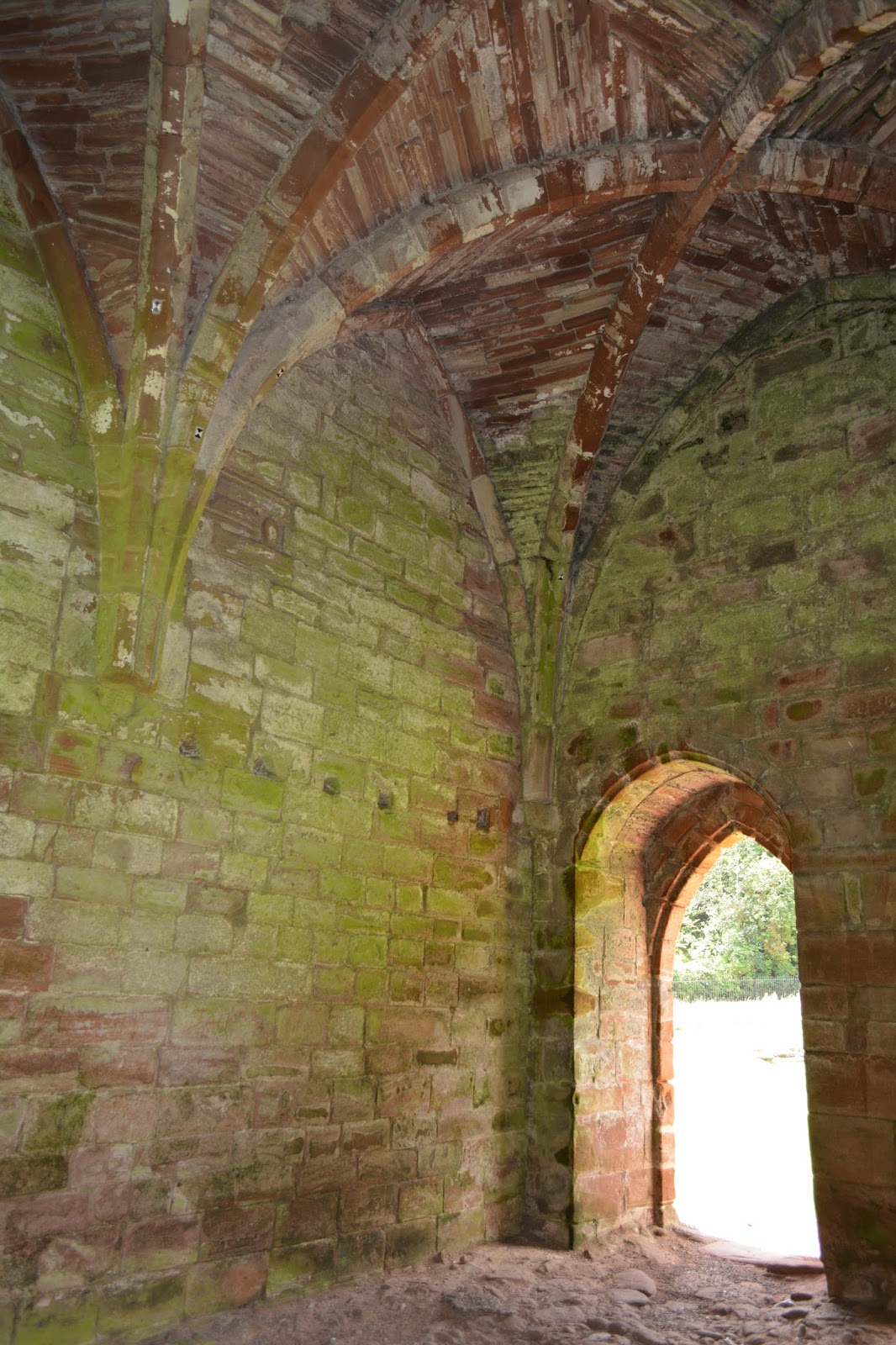
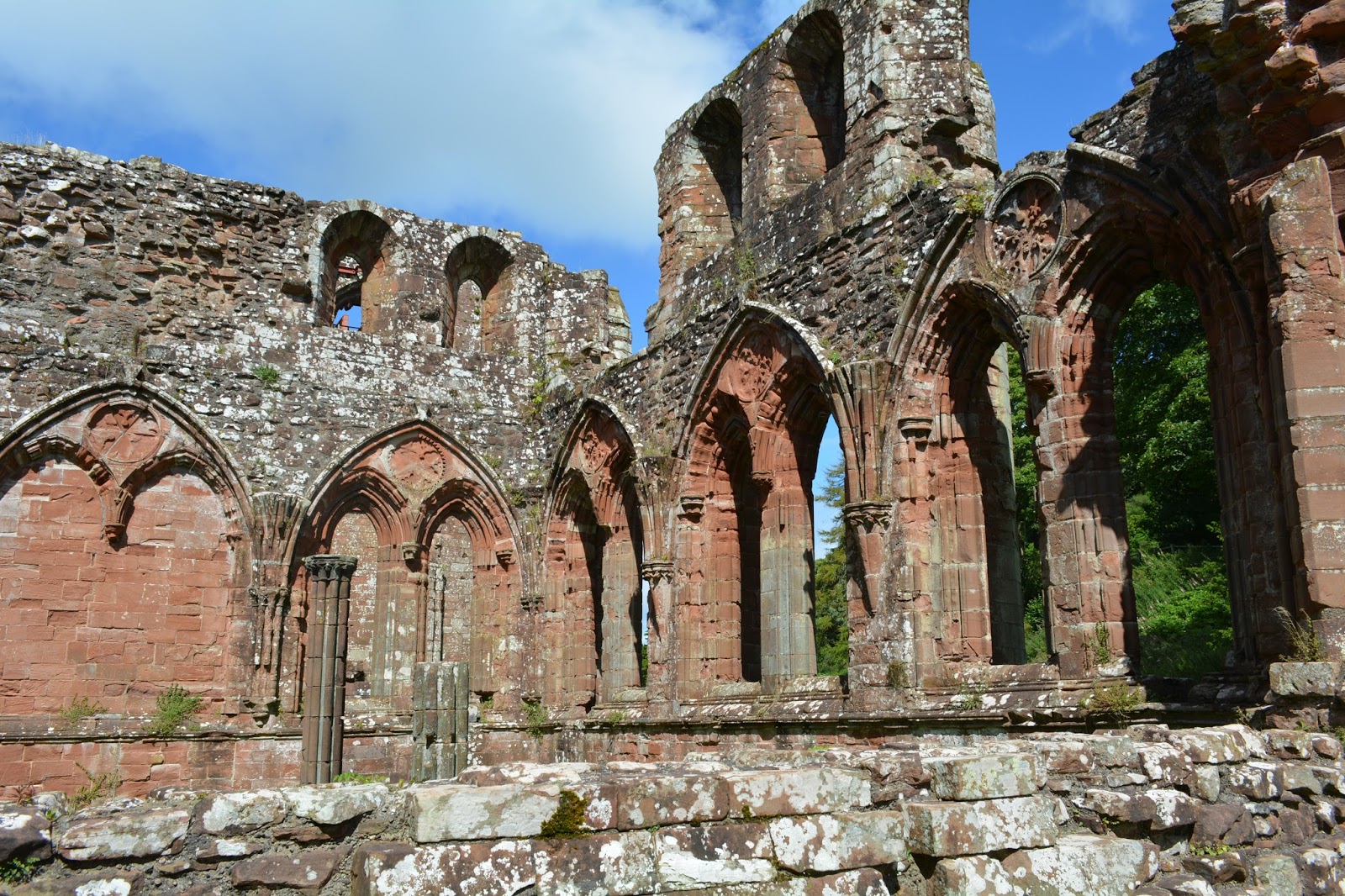
Furness Abbey - Cistercian - c.1123 AD
Furness is one of England's great monastic sites. Founded in 1123 and one of the wealthiest of the Cistercian monasteries, Furness has been a romantic ruin of English lore for centuries. Wordsworth came here. So did Robert the Bruce, in 1322 - the abbot paid for his lodging and put him up, mindful that the Scots, when irritated, had a habit of sacking and looting anyplace less than welcoming to their arrival. On this visit, they did pillage the neighboring villages, and partly destroyed nearby Cartmel Priory, but Abbot John Cockerham managed to save Furness by (nervously) hosting Robert and his boys for the night.
More mutton, Bob? And please don't burn our abbey down.
Built from sandstone, Furness seethes with a ruddy red in the sun (and by now, the sun was out). The grass was a little wet as drifted across the site.
At the center of the church ruin, a robust tangle of bracing and industrial scaffolding crisscrossed the ancient walls. Furness is in the midst of a ten year stabilization program. When the railroad went in a few decades ago, running just past the trees bordering the site, the tracks changed the drainage pattern. The abbey itself, remarkably, was actually constructed atop a series of timber rafts, which had survived more or less intact for better than eight centuries. But once the drainage pattern changed, the timbers started to rot and the surviving walls cracked as the place began to sink.
I was having a hard time wrapping my mind around this idea; a meticulously detailed ten year program, monitored weekly, to preserve an almost 900 year old monastery ruin with hardware that looked like it came from an airport construction site. The preservation of these ancient sites, which the English take very seriously, is a game of millimeters, drawn out over years.
The ruin itself was beguiling and seemed to glow in the summer sun. No one was there, but the place felt busy anyway. The place is evidently teeming with ghosts, including that of a headless monk. On horseback.
In the visitor's center, a display case held a bishop's crozier, that curved doodad thing at the top of a staff. The item was found in 2012 in the church section of the abbey ruin during digging for the stabilization footers. They also found a ring and the skeleton of its wearer, probably a 14th century abbot who was short, overweight and probably suffered from diabetes. They weren't certain whether the crozier was related to the abbot - they think the crozier was older, as the carving depicted St Michael, who was a more commonly venerated saint in the 12th and 13th centuries - but the ring certainly was, likely a bit of bling presented to the guy upon his consecration. They could tell the abbot was portly by how wide the ring was, and they gauged his general health (he died in his forties) by analysis of his bones. They don't know who he was - buried in the church, though, meant that he was probably big swish.
Crozier
Abbot's ring
I asked about the crozier. Although cleaned up a bit when first unearthed, it was still encrusted in some places; it looked like a restoration job left half-done, a toothbrush's scrape away from being all new again. The girl explained that the archeologists removed as much they could safely, and left the rest for future generations of archeologists, when (presumably) the technology for doing such things improved and the work could be completed without damage to the object.
Maybe this is a common practice in archeology - leaving stuff in the ground, or half-cleaning up artifacts with the anticipation that future archeologists with better tools can do it better. The mission to embrace and know the past is a measured one in English archeology. Time plays tricks in the English soil, and you don't always defeat it.
The longest driving day of the trip, which had started at the Westminster Hotel in Nottingham at about 7 in the morning, had pretty well taken its toll on both of us.
I had been cautious not to feel too cocky in advance about the England-by-car thing; it was our third trip, and yeah, the cadences and weird sightline geometry of most roundabouts had started to feel familiar, and the drive on the left thing was second nature, and I had stopped worrying about driving 9% below the limit more less everywhere, it felt like Britain had forgiven me with a sigh and shrug for my timidity.
But driving through Bradford sucked, as did the frantic had-to-pee fiasco in Watford the day before, and I was tired and grouchy as we started to ease into the countryside of Cumbria. But one stop was left.
Shapp Abbey, and sheep
Shap Abbey was one of those "if we have time" sites we had identified on this, the longest single leg of The Journey, and while I probably would have felt fine enough to push onto the hotel in Tirril, I was also eager enough to squirm out of the car for some fresh air and renewed bloodflow to my lower extremities. It was also close - less than twenty miles from the hotel - so, why not? We were losing our light but probably had time, and the glowering skies were withholding of rain.
Founded about 1200 as a Premonstratensian mission, Shap isn't the kind of monastic ruin that's likely to end up on any tourist's "must see" list. English Heritage doesn't even bother collecting an entrance fee. Cumbria is best known as the county of the Lake District, an expanse of rolling mountains (or, perhaps better described by a Coloradoan, very broad and steep rocky hills), punctuated in the valleys by tight and picturesque villages. The English come up here for holiday recreation, boating and camping and hiking; the tourists come for postcard-y photo ops of shimmering lakes and 16th century villages.
The Church tower, c. 1500 - Shap Abbey
The abbey is located at the bottom of yet another steep country lane, barely a car's-width wide, and the ruin itself is a fenced off parcel largely contained within a private farm.
South aisle of the church - Shap Abbey
Chapter house and clergy grave - Shap Abbey
We strolled through the ruin quietly, an occasional sheep breaking the hush. Some abbey ruins gently insist on a hushed reverence, but Shap did so passively, exuding a sullen melancholy that I think took us both a little by surprise. By monastic ruin standards, there's little left of the place; its notable feature being the cracked and gently listing tower, dating to about 1500. And while Heritage dutifully describes the site's original layout, not much is written about the monastery itself, save an obscure little tome written in 1963 and published by Her Majesty's Stationary Office. It was always small, modestly profitable in its day, and was barely missed when Henry's commissioners came for it in 1540. The abbot and his canons were given pensions - bought off, as was common for abbey clergy who surrendered to Cromwell's platoons without a fuss. (Those who resisted usually got the Worst Haircut Ever.)
We had the place to ourselves, shot some pictures. Sat awhile in the chilling late afternoon air. Alone in a place that was used to loneliness. And we went back to the car, and drove away.
We were both glad we stopped here, knowing we'd probably never see the place again.
I wasn't much looking forward to morning rush hour traffic in Nottingham - but we had a long day ahead and not much choice.
Loaded up the Mercedes and up Mansfield Road we crawled toward Church Rock. The cemetery gates were open, but it was a right turn against busy traffic and I just wanted no part of it. Standing the evening before in the light drizzle at the cemetery's locked gates, we had actually discussed strategy for parking the little blue rascal - instead of trying to turn into the cemetery, we'd actually hang a left and head up Mapperly Rd, at the Victorian Church of St Andrew. An impressive CoE building, but clearly a Victorian enterprise that we didn't have the time to visit, and probably wouldn't have anyway.
Hung another left at Cranmer Rd, behind the church (doubtlessly named after Thomas Cranmer, the Tudor-era Reformation figure executed by Queen Mary for heresy, and regarded today as something of a martyr for the Protestant movement), swung around and parked the car. Someone's cat watched us pile out of the car from across the street.
Church Rock Cemetery - Nottingham
Church Rock Cemetery is a sprawling municipal cemetery, tightly packed and draped over a series of swales and gullies. Impressive stonework, and even in the brilliant sunshine of the morning (yes, the sun came out), the graveyard's weird alcoves and cul-de-sacs teased a sense of mystery about the place.
Church Rock Cemetery- Nottingham
It was actually a difficult cemetery to shoot, the sense of scale being continually thwarted by the heaving topology of the place.
At the bottom of a steep walk was an enclosed amphitheater, embracing a number of ground-level stones and a few bricked up alcoves.
Church Rock Cemetery - Nottingham
We climbed down to shoot some pictures, and happened to spy a ramshackle encampment in one of the alcoves, its resident awake and tucked back in shadow. A Polish gangster maybe, but likelier a homeless person. We knew he was there, he knew we were there, but we ignored each other. Apart from that, we were the only ones in the cemetery.
The drive out of Nottingham was easier than I had feared; we caught a break when the GPS had us slip perpendicular and past Mansfield Road and guided us down a few minor, streetlight governed side roads until we reached the on-ramp to the M1.
Roche Abbey was next, unfinished business from our 2013 trip and an easy hour up the M1. We managed to make a wrong turn (we were perfecting the art of getting lost in defiance of a very good GPS), but eventually found the steep cobblestone road down to the English Heritage site. Like many abbeys, at least the ones in the countryside, Roche is tucked into a wooded valley beside a stream, not altogether easy to find.
There was a small car park outside the site, the same one we had parked at in 2013. I pulled into a space and a older gentlemen in a beret walking his dog came up to my window and spoke to me. His accent was impossibly thick, but with a little translation help from Sharon, possessed of an inexplicable gift for being impervious to dense rural English brogues, I gathered he was cautioning me against parking here, as cars in this little area were subject to break-in's by local kids. Hooligans.
"In the middle of the day?" I asked.
"Criminals keep a schedule?" he countered. Well, yeah....if breaking into cars is your thing, you do it when there are actually cars to break into. Roche closes at 5PM, and there'd be little reason to park down here after that.
So we pulled out and proceeded down the narrow lane to the gated site itself.
Roche was founded in 1147 as a Cistercian mission, passed through a number of hands and suffered near-total destruction in 1538, during Henry VIII's maniacal Dissolution. Plundered by Henry's commissioners and locals alike, the site nearly dissolved into the forested countryside until the 1920's, when it was excavated and cleaned up.
Roche Abbey
Set deep in the narrow valley, elegant in its skeletal dignity, it will never be considered one of the must-visit's of England's several dozen medieval monastic sites; for us, it was a gem.
The next leg took us northwest toward Skipton Castle. Sharon set a route that would take us around the south side of the industrial town of Leeds, but it did take us more or less directly through Leeds' small satellite city Bradford. A tangle of fast, busy roads with tricky last-minute moves and jammed with impatient delivery truckers, it was probably the hardest single day's drive of the whole two weeks.
Skipton Castle
We had had our doubts about Skipton. An extraordinarily well preserved medieval fortress, founded in the late 11th century, the castle is now a privately owned tourist attraction. Privately owned castles can be a hit-or-miss proposition. Sudeley Castle, which we visited in 2012, was a disappointment - crowded with vendors and costumed performers, the place felt like a Tudor-era theme park, and it was a turn-off.
Lady Clifford (1590-1676)
But Skipton was a more subtle and intimate experience, an intriguing stroll through narrow hallways, yawning banquet rooms and tight stairways, all wrapped around the Conduit Courtyard. Besieged in the English Civil War by Cromwell's forces before finally surrendering in 1645, Skipton was spared the worst of the Parliamentarians' usual slighting, with only the roofing removed upon their departure.
...and her Yew tree, planted in 1659
It is said that the castle's owner, the feisty and stubborn Lady Anne Clifford, planted the Yew tree now standing the courtyard as commemoration of the the castle's restoration after Cromwell's departure.
Got dragons? Coat of arms in the Conduit Courtyard - Skipton Castle
Skipton Castle interior
Counter-intuitively, you have to park up the steep hill from the castle, and walk down to it. It was late afternoon by the time we made our way back uphill to the car, and we spied the bumper-to-bumper traffic down toward the town square with exhausted dismay. Deep in the reaches of sheep country of North Yorkshire (its name actually derives from the Old English, sceap), Skipton is a deceptively sizable town, and what we were looking at was a kind of rural rush hour. The GPS had anticipated our heading back through town, but forget about it. We made a left out of the car park instead; our little Garmin, by now accustomed to our willful non-compliance to its perfectly reasonable demands, dutifully traced a new route for us through some minor country roads outside town, until we were properly headed toward Cumbria.
During the course of our 15 minute impromptu car-park chat with Christopher (we talked driving in England, visiting old buildings and life in America), we noted our fondness for old English graveyards - the churchyards and the Victorian-era municipal cemeteries alike - and our eagerness to explore Church Rock, one of England's best muni's and one that had eluded us on our two prior trips to Nottingham.
We were worried about rain, but Christopher alerted us to another potential peril. Polish gangs, who evidently lurk the cemetery at dusk and at night, sparring over turf (some turf to fight over) and being generally menacing. Evidently part of their trade is illegal cigarettes - not necessarily a surprise, as legal ones are extortionately retailed throughout England.
The term "Polish gangs" struck an odd note with us, a concept lacking resonance for a couple of American tourists, but it still gave us pause as we looked nervously down at the Nikons swinging at our chests.
"Sometimes they're in there at night," Christopher noted, "and sometimes the Police chase them out. You'll probably be okay."
My wallet, brimming with pound notes, was on the nightstand in our room, and I thought, eh, maybe I'll leave it there.
But the cemetery was closed anyway.
We ambled down a few side streets toward City Centre. At the Market Square there seemed to be some sort of fair in progress - multi-colored lights, rides, vendor stalls - conspicuously sparkly against the grey of the evening and the grimly imposing Council House.
What if they gave a fair and no one came?
But...no people. Was the fair over? Or not yet begun? Had heavy rains earlier chased everyone anyway? A post-apocalypse scene, a Fellini-esque dream fugue? An hallucination?
We climbed the hill toward the Castle. Normally a tourist magnet, the Castle was closed by this time, and probably little visited on a rainy Monday anyway.
Nottingham Castle
Our friends at wikipedia tell us that the Castle was built originally by William the Conqueror in 1067, a stronghold to secure his occupation of Mercia, but the structure there now has little material relationship to William's castle. Rebuilt by Henry II, destroyed, re-built, and destroyed again, the original stone foundations dating to the 13th century are visible at ground level, but most of the rest was built in the 17th and 19th centuries, and the castle now stands as a museum and art gallery.
In the adjacent courtyard, Robin Hood (this is Nottingham, after all) is poised with bow and arrow at the ready, a few statues of Robin's homies stand nearby.
'ello, Robin !!
The Trip
The Trip wasn't far from the Castle, just a quarter rotation around Castle Rock. The place was originally carved into the stone as the castle's brewery, the ale hoisted up through a hole in the stone ceiling.
The ancient Trip - with the ale hoist at the top.
The place itself is really two distinct dwellings - the timbered Inn, which dates to the mid 1600's, and the inner Inn, carved into the stone and dating to 1189. It is said that Richard the Lionhearted stayed at the Inn on his way to the Third Crusade.
Looking up at the ale hoist.
Our server guy seated us in the old section, a tiny stone-walled room up some steps from the timbered Inn section, a room with barely enough space to seat 10 diners. Various swords and other medievalia adorned the walls,
Inside the Trip.
and the legendary Cursed Galleon, draped in dusty cobwebs and enshrined in a glass case, stood on a shelf just over my shoulder.
Dust me, face yer doom...
It is said that anyone who cleans the thing meets an untimely death - so no one cleans it anymore, and exactly how a ship model can gather dust inside a glass case remains a mystery.
The food was beefy and generous - Glen our server recommended the Abbot's Brown ale, supposedly a recreation of the brown ale served here in medieval times, from the original recipe. It was bitey and a bit heavy, but otherwise nice; something told me it was probably crafted nearer to 21st century palettes than 12th century. I had a couple. Er...maybe three.
Dinner finished and both of us aled-up, the bartender kindly called us a cab for the two miles back to the hotel. We were tired and it was raining. While we waited, I hung in the main pub area and watched as some locals were testing each other on the Trip's (evidently) renowned bar game: a ring hung from a ceiling chain is swung across the room to catch a hook at the far end of the pub. I don't know if this too had a tradition extending back centuries. Each of the three guys took a couple of turns at it, all to no success. Harder than it looked, I thought to myself. I just watched. One of them turned to me asked it I wanted to "give it a go."
I shrugged and said ok. Lined up carefully facing the hook, which I could barely see. The image of dart-throwing I had seen in pubs in England - an elegant, gently-focused, simple-motion technique - flashed through my head. Don't fling it, just coax. I let the ring go and - bam - I hung it. First try.
The three guys were flummoxed-impressed, as was I. "You've never done this before," the guy said.
"No, mate, I'm from out of town."
We high-fived and they bought a round of shots. I got a little sticker-of-honor from the barkeep, who was also suitably impressed.
After a day of pitiless rain, re-clutching cars, cheating bladder expulsion on the M1, getting lost in Nottingham, puzzling over deserted festivals and dodging scary Polish cigarette contrabandits...a moment of triumph at the Oldest Inn in England.
One of our 2012 trip's highlights, if you could call it that, was our determined effort to avoid Swindon, a largely industrial city in the eastern reaches of Wiltshire. (Andy Partridge from the alt-quirk rock band XTC is a life-long Swindonian and something of an erstwhile cultural spokesman there.)
It was on the leg that would take us back to London from Wiltshire, after prowling the neolithic mysteries of Avebury and West Kennet Long Barrow, and the real reason we pasted a skull and crossbones on it was to avoid the Magic Roundabout, a truly malevolent intersection famously regarded as England's scariest place to drive.
Swindon's Magic Roundabout, from a safe distance.
Avoid it we did.
What we didn't know when we left Watford, emptied of bladder and properly re-clutched with the Mercedes, was that the directions the EuropCar gave us thankfully guided us just past the SECOND scariest to drive in England, the six-circle roundabout at Hemel Hempstead.
At least they have some trees in the center. Hemel Hempstead roundabout.
Neither of us recall him even mentioning it, but had he sent us to the next exit north of Watford to gain access to the M1, this motorist-munching monstrosity awaited.
We didn't discover this bit of good fortune until weeks after we had returned to the States. Half tempted to go back and thank the dude all over again.
We were headed to Nottingham to meet up with our friends from Past Hauntings - Sean, his wife Sarah, his kids and associates - for a ghost hunt somewhere, but the weather was rainy and on the way north Sean texted us that Sarah was ill and they had to cancel for the evening. We had a room booked, so we were going anyway, but we now had the evening free.
The drive into Nottingham - through its inner-ring suburbs and winding, hilly streets - wasn't much fun, and we fumbled through a couple of bad turns before we found the Best Western Westminster (not sure why it was called that, since it was nowhere near Westminster, a London borough) on Mansfield Road, one of the two or three main thoroughfares through Nottingham.
We had wanted to hit Church Rock Cemetery, the sprawling and vaguely foreboding graveyard right in the middle of town.
But after dropping off the bags and spending some time chatting in the car park with Christopher, a friendly and slightly disheveled 30ish local who ambled up to us and expressed some interest in our Mercedes, we walked up the road to find that the cemetery was very, very closed, Locked tight. We'd leave that for morning.
Walking to the cemetery....something told me I didn't want to drive thru this. But I did anyway, the next morning.
Church Rock Cemetery - the next morning
Instead, a quick check on our GPS indicated that Ye Olde Trip to Jerusalem, the self-proclaimed "oldest inn in Britain" and one of Nottingham's most famous tourist attractions was a mere mile's walk from the hotel. Easy decision; the weather was holding, we were both hungry and in need of sudsy sustenance after a brutal day on England's roads, and we had wanted to see this ancient place for a long time.
The synapse-snapping ordeal of driving through rush-hour London on our first trip, learning the cadences and perils of UK driving at exactly the wrong time and place (and getting lost), inspired a teachable moment for our 2013 trip - namely, get the car well outside of the city center. make an easy beeline to the highway, don't forget to exhale.
So it was that for the 2013 trip, we picked a lonely little rental car office in Edgware, a non-descript neighborhood in far northern London (and after which the great north-south London boulevard Edgware Rd is named), to get the car, conceding the 40 pound taxi ride out there from Paddington as a necessary expense. Two turns and two drop-shot roundabouts to the M1.
Outside the Edgware EuropCar office, in 2013.
Simple enough, except that office was closed for late summer UK Bank Holiday in 2013, and we ended up fighting London traffic anyway. The strategy was sound...in 2013, the timing was faulty.
This year we followed the strategy again, and the office was expecting us. An early morning car run out to Edgware (alright, fifty quid, but who's counting?), in the intermittent rain, and we were in. We waited for a fussy, fur-bedecked lady to get her keys, and approached the desk.
Two years is a pretty long time, but I did complain a bit about the 2013 fiasco; the guy behind the desk, probably making little more than minimum wage, seemed stumped as to how exactly to respond (it wasn't his fault, obviously, and he likely didn't have much authority to apply any compensatory grease to this year's rental agreement), but we ended up with a sky-blue Mercedes A120 hatchback.
Bring me my chariot of fire.
A Mercedes? Well...a really little one - diesel, which was okay - and not exactly an Autobahn burner. Did we get a Mercedes because of the 2013 snafu? Who knows.
Paperwork all sorted, they pulled the car out, went through a perfunctory button tour (key note here: perfunctory), and I successfully navigated a tricky right turn across traffic to head up to the M1. Exhale time?
Well, the two roundabouts between Edgeware Rd and the M1 were less straightforward than they first appeared and I got beeped in both. Shake it off, lad.
The long approach ramp to the M1 felt nice. On the highway at last, a teachable moment redeemed. Let's go to Nottingham.
After a few miles, the traffic on the M1 began to slow. Eh, highways do that. Then slowed some more. Then stopped. Crept forward. Stopped again. Dead stop. Ten minutes passed, crept forward, stopped again. WTF?
Speedo at 0.
Two and a half hours of this. Traffic jams are a modern feature of every industrialized nation, but this was getting stupid. Past stupid. Just not right.
Sharon turned on the radio to kill the pitiless monotony of lorries dropping clutch for their 40 yard creep and hissing their brakes for the inevitable stop. It was raining. We both had to go to the bathroom. This was getting really bad.
We happened to catch a traffic report that the M1 was closed in both directions due to a serious lorry accident; northbound traffic was being diverted off at Watford. Well, not looking forward to being in an unfamiliar place with 60 million impatient drivers, feeling the veins in my bladder stretching like overtuned piano strings. But we didn't have a choice, and eventually crept up to the exit ramp at Watford, drowning in a super-highway's volume of traffic, facing a hideous tangle of access and frontage roads. The crush eased up as side roads began to irrigate traffic in different directions, but we were still lost, still needing to pee.
And what was happening to the Mercedes? As if tranquilized by the traffic jam, the damn thing wouldn't shift out of first gear. As the traffic began to move, I tried to keep up, screaming in first gear, getting beeped. There were paddles on either side behind the wheel; I tried one, shifted to second. Wow. This thing is a clutchless manual shift all of a sudden. HONK. Shifted to third. Traffic stopped ahead, down shift, left paddle. Where are we going? Go left here. Why ? HONK. Just do it, I have to go to the bathroom. Look out !!! HONK. There's a bathroom that way? Or go that way. Turn on the GPS. HONK. Turn here...never mind, too late. Upshift. Turn here. HONK.
Sharon had the portable GPS going, turned on her phone GPS and tried to figure out where we could find a gas station. The GPS' were giving us conflicting instructions, and she was vetoing both. Before long we'd both have pale fluid oozing from our eye sockets.
We descended a long street through the probably-very-nice town of Watford and like a beacon of hope for all mankind, a BP station appeared dead ahead. On the left side of the road too, an added bonus.
The BP station, Wiggenhall Rd, Watford.
It was drizzling. We pulled into a side parking space (we didn't need gas, having burned virtually none in the prior three hours), Sharon raced in for the bathroom, came out and passed the baton.
Both relieved, we still had a problem. The car wouldn't shift without paddle-assist, and our brave little Mercedes had no manual. We were 10 miles into a 1200 mile, ten day expedition. Paddling is for rivers.
At that moment, fighting off despair, a EuropCar courtesy van (no kidding) pulled into the petrol station, and a tallish, bearded guy of about 32 started pumping gas. I approached him ("Hello, friend," I stammered, immediately realizing that I sounded like a 19th century Amish elder, but for some reason that's all I could managed as a greeting...), explained our dilemma, and he came over, climbed into the car and explained that, while Sharon was slamming console buttons trying to wipe girl-pop off the radio, she accidentally hit the Transmission Mode button, silently changing the tranny from Economy to Manual. The button had only an obscure little icon on it, and no one at Edgware explained it to us. Since we were stuck in first gear for 2 hours anyway, backed up on the M1, we didn't notice until we were liberated at the Watford exit.
He also explained that they probably didn't include the manual because, really???, people steal them. So either this little pony's book was in some drawer in Edgware...or someone had already pinched it, for reasons life isn't long enough to speculate about.
We thanked the guy to the point of embarrassment - he found it all kind of amusing, although thankfully not in a 'tosser stupid Yanks' kind of way.
He gave us directions (more or less) to get out of Watford and head back north, bypassing the M1 backup, and we were finally headed toward Nottingham.
We gave up on the radio, and never turned it on once after that.
I suppose it's a common practice for hotels near a train station to let you leave your bags before you can check in - makes perfect sense - so we probably over-thanked the nice Eastern European girls at the Norfolk Towers front desk for something they do all the time. Groggy, mutedly thrilled to be in London in the first hours of a two week adventure, I was thanking everybody within arm's reach.
Relieved of the bags, we thought we'd just head out and walk.
Hyde Park, London
Hyde Park, one of London's great green spaces, wasn't far, so we ambled down with Nikons around the neck and eyes on the sky. For a city so renowned for rain, the skies that day were curiously diffident. Drizzle here, sprinkle there, brightening and clearing, then rain, then mist. I had actually bought and brought a rain jacket for this trip, but I left it in the luggage (figures).
Outside the gates of the Park, a vendor was selling hand-painted pub sign miniatures, hundreds of them. Tourist commerce isn't usually our thing, but we were free agents in one of the world's great tourist cities, and we browsed, eventually settling on three.
Genuine pub sign facsimiles
It was a warmly validating experience to hand over some British currency. The guy said his dad started the business over forty years ago - they have to buy a very pricey monthly license from the City to sell at the Hyde Park gates. Even in the rain, though, it looked like business was okay. We did our part.
The rain ebbed and swelled as we strolled through the Park. I restrained myself from fearing that we would be dodging rain for the next two weeks. At one point we settled into a couple of vacant, old-fashioned beach chairs
Guy on the right sits for free - the rest of us, not so much.
perched under a large tree, minor shelter from the drizzle, until some lad with a genuinely bizarre accent came up to us and informed us that the cost of using the chairs was £2 per half hour. We thanked him - well, I did, because I was still thanking everyone - and vacated the chairs, which were pretty well soaked anyway.
We talked about what next. The Natural History Museum was just on the other side of the Park, which sounded closer than it really was, and while Sharon had talked about seeing it, we decided instead to do a cemetery, defiantly optimistic about the weather. We headed back to Paddington Station, where we discovered that the Paddington tube stop wasn't actually at Paddington Station, but across Praed Street and down a block or so.
Time for lunch.
Up the escalator at the Station, we found the Paddington Store, which is the only authorized outlet for genuine Paddington Bear stuff - books, mugs, pens, posters, bling, shirts, plush of all sizes (including a pretty pricey Steiff) ...and lots of copies of the DVD, which we already had. The nice young man (who I also thanked) told us that the DVD was still selling well, and that the film run was a Pretty Big Deal in London the prior December when it hit the cinema. Sharon found a nice little bronze miniature of the statue.
We sat down in a restaurant a few doors from the store, a dreary brass-rail chain joint with a projection TV showing Formula 1 racing and a handful of patrons noodling on their phones, ordered some forgettable bar nosh and left as soon as we could. I wasn't really hungry, and I don't think Sharon was either, but it seemed like the thing to do.
At some point, we thought we'd take the sleepless Sunday morning in London to head up to either Highgate or Kensal Green cemeteries, both members of the Magnificent Seven, but we had now reduced our available daylight hours, and still mindful of the weather we opted instead for Paddington Old Cemetery, which was sort of nearby Paddington Station on a subway map, but not really nearby on a shoeleather scale, and the weather wasn't encouraging for long walks...unlike 2013, when we ventured far from Chelsea to hit Fulham Palace Road and Margravine cemeteries, winding us around weird neighborhoods and hospitals and grim playgrounds and Costa bladder-relief stops.
Paddington Old Cemetery
It took some doing to figure out the Tube diagram, but we managed to find the right platform and boarded a train that would take us to Queen's Park, a non-descript neighborhood of NW London. The Tube stop was actually a mile or so from the cemetery, so we had a chance to walk a bit through a non-touristy section of London, a subtle indulgence that we both had come to appreciate on prior trips. Like any great city, London is characterized by its postcard-y landmarks and iconic locales, but it's also a place, with schools, dry cleaners, shops, houses, bus stops. Putting down the camera for a few minutes and just being there is part of the experience as well.
Paddington Old Cemetery isn't particularly old, nor (as noted) particularly close to Paddington Station, but it was a well-kept, reasonably ordered Victorian graveyard, essentially laid out around a central chapel. The chapel appeared to be in pretty rough shape, fenced off and apparently undergoing repair.
Gothic revival chapel and gatehouse, Old Paddington Cemetery.
The Victorians took their burial stonework very seriously, and the combination of a century of toxic industrial air and London weather, as well as diminishing care through generations, leaves many of these graveyards in disrepair. Every Victorian cemetery we've encountered in London has a "Friends Of.." association to raise funds for the cemetery upkeep, and few if any of them ever have enough to keep up with the grinding ravishes of weather and neglect.
We strolled the neighborhood and outside the tube stop we encountered a girl - junkie, we presumed - panhandling for spare change, pleading that she hadn't eaten in two days. All I had on me was (inexplicably) some US coinage, which she wasn't interested in, and Sharon found her pushy and less than plausible as someone in genuine straits. We're generally sympathetic to struggling street folks, but her pleas were cheap and off-putting and we passed.
We headed back to the hotel, prowled the neighborhood a bit,
St Mary's Hospital, Paddington
and finally checked into our room. Impossibly tiny, the room was nonetheless comfortable and weirdly quiet, counter-intuitively the quietest hotel room we had on the whole trip.
After some chill time, we headed back out to a pub around the corner for an early dinner. Fountains Abbey, it was called, oddly named after the magnificent Cistercian abbey ruins in Yorkshire we had a chance to visit on our 2013 trip. The place was nice enough and the service was okay, but the food was pricey and not very good. We were both pretty whipped by this time, so after eating and downing a couple of pints (the bar was selling Coors Light, on draft - a cruel joke, I thought, in a country renowned for its ale, but it wouldn't be the last time we'd see it), we went back to the hotel, assembled our clothes and paperwork for the next day and konked out.