"
Fountains Abbey," I replied over my shoulder when the Buzzard Sisters asked what was on for the day, and I hurried as best I could toward the car, hoping to escape an explanation of what exactly that was, since I was pretty sure they wouldn't know.
I had grown to regard their presence - every morning, every evening, right there in the garden at the same table with Buddhic resolve - as something of a blight, which I suppose is a little unfair since they were reasonably unobjectionable in demeanor and only mildly intrusive toward the people around them.
Still...I just wanted to holler at them. Put down the Harvey's Bristol Creme and
do something, already.
Sharon chafed a bit at my irritation; they seemed to be doing exactly what they wanted to do, she shrugged. So what? Let 'em do nothing.
Fair enough. At least they didn't ask us for a ride anywhere.
St Cuthbert's in Crayke was up first, a dour late 15th century number on a slight hill in a village of barely 400 people.
 |
| St Cuthbert - Crayke |
 |
| St Cuthbert - Crayke |
 |
| St Cuthbert - Crayke |
I liked this place; while not as ancient as other churches we went out of our way to see, it exuded a sullen, plain, workingman humility, with little of the awkward Victorian re-dressing that hang on other churches like ill-fitting vestments.
 |
| St Cuthbert - Crayke |
We shot the church and churchyard in short order, and took off.
Easingwold is a pretty big town, about 4000 people. Being without my morning diet soda, we pulled into a very tight mini-mall off the main drag and Sharon hopped into the market to fetch one for me. The car-park was a knotted hive of cars entering and exiting from both ends; maybe this is the only market in town I thought, although I'm sure that isn't true, and while I had by now long accustomed myself to
driving on the left, on my way out I had a sudden case of brain lock as to the presumed etiquette of which side of a
parking lot to drive on. The folks I held up doing my hurried and embarrassing 5 point turn were patient and gracious - "no problem, luv" a nice lady said through her driver's side window as I apologized to her on my way out. That made my morning.
St John and All Saints is also a pretty big place, although not as old as the town, which dates to the
Domesday Book. The church is fourteenth century; as is common for churches of this particular time, there are (or there are believed to be) remnants of the earlier Norman or Saxon church in the building fabric, despite a jarringly modern glass door at the entrance.
 |
| St John and All Saints - Easingwold |
The place was impressive. It was also locked, but we had a little cheap fun shooting the cemetery sheep from the meager and newer-section easement of the churchyard, the older section of which was given over to grazing.
 |
| More cemetery sheep. St John and All Saints - Easingwold |
 |
| Baah - St John and All Saints - Easingwold |
 |
| St John and All Saints - Easingwold |
We walked back to the car. A youngish mother walking with her fussy 7 year old. 'You're embarrassing me,' we heard her say to him, 'no, you're embarrassing
me ' the 7 year old replied, and I was really sorry we couldn't hear the conclusion of this debate, as the score appeared to be all tied up.
The route to Fountains took us through the ancient market town of
Ripon, home to
Ripon Cathedral, one of the North's great houses of worship with a history dating back to 650 AD. I had wanted to see the cathedral since we were in this area last year, and I caught a fleeting glimpse of it as we drove through town. But we decided to continue on to Fountains and hit the cathedral on the way back if we had time; neither of us thought we would.
Fountains Abbey and the grounds surrounding it are listed as a
World Heritage site, in addition to being one of the jewels in the
National Trust's crown.
 |
| Fountains Abbey - approaching the Abbey ruin |
The entire complex is almost 700 acres, including
Fountains Hall (built around 1600),
 |
| Fountains Hall - Fountains Abbey |
Studley Royal Gardens (constructed around 1700) and the immense
St Mary's Church, built in honor of a wealthy Englishman named Frederick Grantham Vyner who had been kidnapped and murdered by Greek bandits in 1870; Vyner's brother-in-law, The First Marquess of Ripon, George Robinson, had this church constructed in Vyner's memory in 1871.
The site's history is a long and tangled tale of monastic rivalry, Scottish raids, Reformation politics, royal confiscation and a little rich-guy vainglory; but in the early 21st century, the place is just a huge walking park, with a massive Cistercian abbey ruin right in the middle.
 |
| Fountains Abbey |
 |
| Fountains Abbey |
It's also a fairly popular "day out" destination for the British, and in addition to camera-toting tourists (like us), the complex was buzzing with family picnickers, hand-in-hand lovers, grandpas walking with toddlers, chubby housewives pushing strollers and slurping at ice-cream cones. Fountains has a kind of historic-amusement park feel to it - not terribly unlike
Sudeley Castle, one of our not-so-great destination choices from last year - but the site is immense, we never really felt cramped, and all of the commerce (the souvenir shop, the cafe, etc) is located at the entrance.
The Abbey is massive, one the most complete medieval monastic ruins in all of England, despite being plundered by Henry VIII in 1539 and again by a private owner at the beginning of the 18th century; several sections were still holding up a roof, the looming 15th century Tower and its carved heads standing guard over it all. We spent two hours picking our way around the site, shooting pictures in the vain hope of trying to capture the scale of the place. Sharon remarked that it was a good thing we had visited several other ancient monastic ruins before coming here, as it helped us appreciate Fountain's vastness without allowing it to diminish the others, all of which are smaller and far less complete.
We'd find a good angle to shoot a picture, then wait until for the other people there to drift out of the frame. It's funny thing, or maybe common at a place like this, wanting to keep the images un-besmirched by strangers. Sometimes it wasn't possible. But the net result is that we have hundreds of pictures of these remarkable places, and many of them have no one else in the frame, encouraging us to remember the place as being ours alone. Which wasn't the case at all - Fountains was busy. It's probably
always busy.
Odd thing; you use photography to help you remember the place, but also use it to subtly manipulate your memory. Do you photograph the place, or photograph the experience?
 |
| Fountains Abbey |
 |
| Fountains Abbey |
Kirkham Priory was easy - we
were the only ones there. I read a piece not long ago on a travel site about not falling into the trap of shooting so much that you forget to
actually be there. Sharon doesn't think we fell into that trap. I'm still thinking about it.
Pheasants accompanied us on the walk up to the church.
 |
| Aaaaggghh !!! |
Twitchy little things, they darted between bushes where they cooed in communal security until startled and forced to find a new bush to hide in. What a way to live.
The Church stands alone at the top of a hill.
 |
| St Mary's Church - Fountains Abbey |
The place is impossibly ornate on the inside, a little on the garish and artificial side we both thought. Gothic revivalism, I suppose, or something like that.
 |
| Tilework at the altar - St Mary's Church, Fountains Abbey |
The famed German-born architectural historian
Nikolaus Pevsner thought very highly of this place, calling it "a dream of early English glory," but it left us both feeling a little cold.
 |
| St Mary's Church - Fountains Abbey |
 |
| The First Marquess of Ripon, George Robinson - St Mary's Church, Fountains Abbey |
There was an older German couple inside; the gentleman remarked to me, "ah, the playthings of the rich..." and that about captured it for us. It'd be presumptuous of us to cop an attitude about what an English church should and shouldn't be, but the place didn't feel particularly sacred to us.
We saw Ripon Cathedral again from the road on the way back to York. We were both pretty beat from the lengthy walk around Fountains. Ripon would have to wait until next time.
Back in York, we headed over to the
Golden Fleece for dinner.
 |
| The Golden Fleece - York |
 |
| One more, luv, and then I've REALLY got to be going. The Golden Fleece - York |
The sixteenth century pub is thought by many to be York's most haunted establishment - we had given some thought to staying there a night or two, they have four or five lodging rooms upstairs, but the place is on one of the town center's busiest streets and there was no parking. Too bad; the building is standard-issue timber-framed Tudor, with low ceilings and creaking, narrow hallways. We may stay there if we go back. That may not be for two years. Presumably it'll still be haunted then.
We got a table in the outside patio, and got a little bonus treat when the
York Terror Trail group came through to hear the last chapter of tour (something about a ne'er-do-well young man who seduced a judge's daughter, beat the hangman's noose and went on to live a respectable life), delivered by a thirty-ish Michael Palin-lookalike named Joseph. He joined us at our table for a pint after dismissing his group.
We talked a bit about English history ("No, I don't think people here appreciate it," he said, "they're surrounded by it...") and York, and making a fun but meager living from the city's tourist trade. This was a temporary gig, of course; he had his sights set on an advanced degree in mathematics at a university in Germany and was just waiting on his EU-sponsored tuition subsidy paperwork to come through, trading off a little theater experience he had in school in the meantime. He shared our genuine fondness for York and enjoyed the tour-guide gig well enough, but was ready to move on.
Then a guy dressed like
Guy Fawkes showed up.
 |
| Guy Fawkes, a topped-off pint and all is well - The Golden Fleece, York. |
He didn't appear to be in costume for any particular reason...maybe he dressed like Guy Fawkes all the time. Maybe it
was Guy Fawkes.
I fired off a few shots of the Fleece on our way out,
 |
| Front bar - The Golden Fleece, York |
 |
| Odd hooded figure in the front doorway - The Golden Fleece, York |
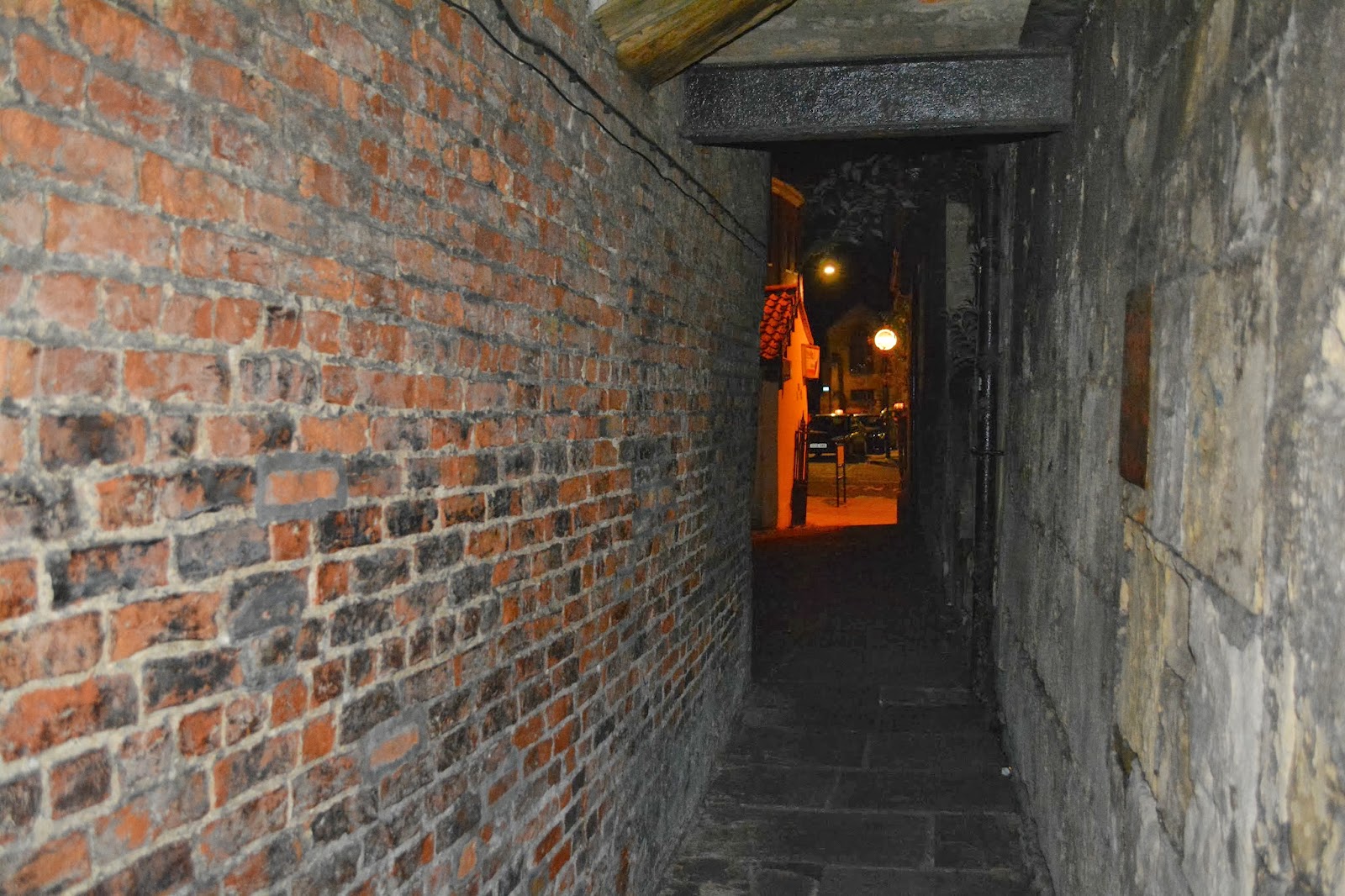
and we took the long back to the hotel, prowling our way through York and its dark medieval side streets lined with odd shops and tea rooms, brimmed with woozy pub crawlers and surveyed mutely by a few of York's famed
cat statues.
 |
| York by night |
 |
| York by night |
 |
| York by night |
 |
| Sharon, York by night |
 |
| Cat statue - York |
 |
| Cat statue - York |
It was a perfect evening. Perfect.